

[Fall 2021]
Paul Walde, Requiem for a Glacier
By Reilley Bishop-Stall
Montreal Museum of Fine Arts
March 10, 2021–February 27, 2022
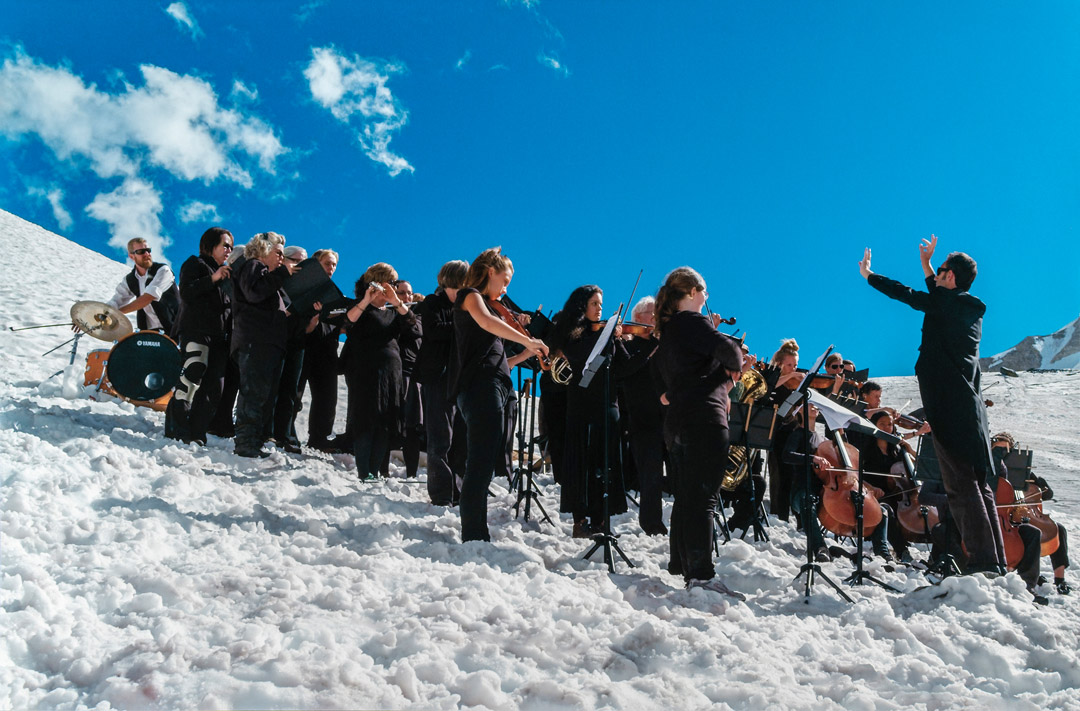
Paul Walde’s four movement oratorio Requiem for a Glacier was originally performed in July, 2013 on a glacier in British Columbia’s Jumbo Valley – or Qat’muk, as it is known by the Ktunaxa First Nation, the region’s original stewards. At the time of the performance, the ancient glacial area was under direct threat of both climate change and resort development, as the building of a (now cancelled) ski resort had obtained provincial approval despite resistance from environmentalists, local residents, and the Ktunaxa. Performed for the glaciers, with only the fifty musicians and thirty crew members present, the event was described in the press as a protest, an homage, and, of course, an expression of grief. For a space considered sacred by Ktunaxa, the grandiosity of the requiem gesture is both appropriate and questionable as it honours the spiritual import of the area, but in a language and tradition historically imposed on Indigenous lands.
Footage of the event was later incorporated into a video installation of the same title, in which the recorded oratorio is accompanied by field recordings and the visual documentation is supplemented with long shots of the landscape, vignettes of individual performers, and temporal and visual effects that mirror the dramatic urgency of the oratorio. The installation is on display at the Montreal Museum of Fine Arts as part of the exhibition Ecologies: A Song for Our Planet, curated by Iris Amizlev.
Loosely based on a Catholic requiem mass, the score is evocative not only of mourning but of an odyssey or a struggle, the audio and video working together to construct something of a narrative arc. Walde drew on a variety of sources to compose the score: the first two movements are generated out of the letters j-u-m-b-o, referencing both the non-Indigenous name for Qat’muk and the controversial resort; the libretto is a Latin translation of a 2012 press release announcing the BC government’s approval of the resort’s development; the third movement is drawn from data detailing temperature readings of the area from 1969 to 2010, with the increasing tempo reflecting rising temperatures; and the final movement pairs instrumentation with a droning hum to mimic the presence of an electrical power grid. All four movements are animated by the video in ways that distinguish the installation from the initial performance. As rising temperatures are translated into musical notes, soprano Veronika Hajdu is pictured walking in slow motion, taking step after arduous step across the glacier’s surface. At more than one point in the video, a black rectangle appears overtop time-lapse footage of the mountain range, like a censor-bar blocking access to the image. In one instance, the shape slowly expands to fill the frame; in another, a timpano conjures thunder to accompany a lightning storm. Interspersed throughout the score are field recordings of dripping and running water; it is, arguably, this sound of melting that is the most melancholic.
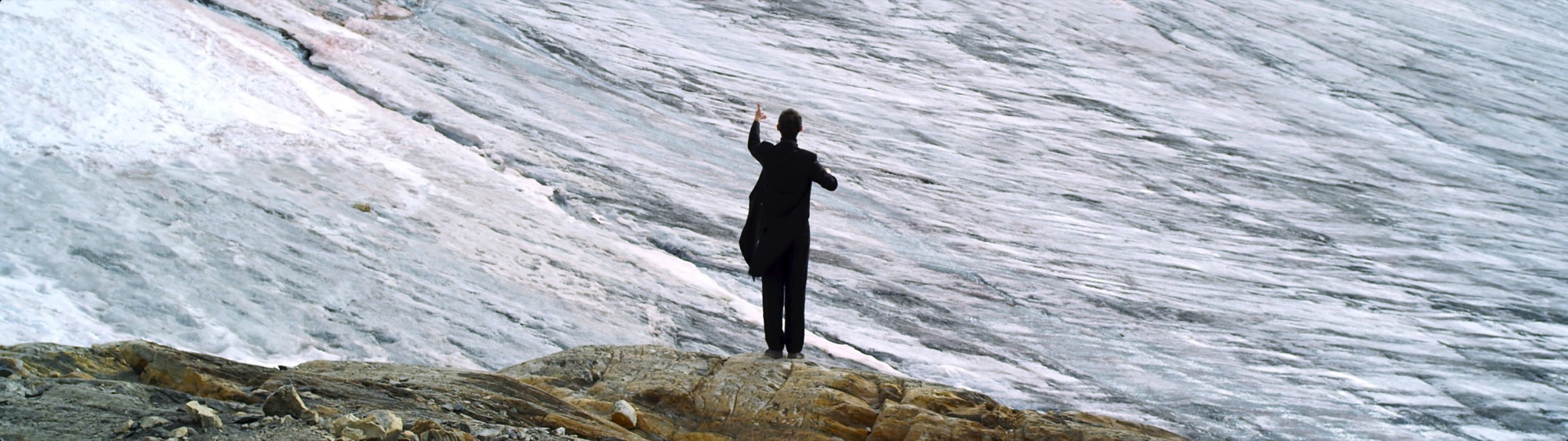
Visually, the evocation of melancholy, of Romanticism, and of the sublime is undeniable. The piece ends with what others have agreed is a clear reference to Caspar David Friedrich’s Wanderer Above the Sea of Fog (1818). The slender figure of the conductor, Ajtony Csaba, dressed in black tails, stands in the centre of the screen, filmed from behind, against the immensity of the mountain range – a rückenfigur, contemplating not only the awesome environment but, perhaps, its precarious future.
Although Requiem for a Glacier is included in the MMFA show, it is displayed in a separate wing of the museum. Visitors are therefore able to immerse themselves in the installation while also considering it in relation to the broader climate concerns tackled in the exhibition. When it was first performed, in 2013, it was directly linked to then current and regional politics. As of January 2020, after a thirty-year-long dispute, the controversial resort development has been permanently abandoned. The Ktunaxa have partnered with government and environmental organizations to preserve the area, with the First Nation back in charge of stewardship and conservation. Despite these political shifts, the area remains vulnerable to the effects of global warming, and Walde’s installation remains evocative and arresting. The dispute over the glacier range encompassed, but often overrode, Indigenous territorial and spiritual claims. The projection of such a distinctly Christian and European lamentation as a Latin requiem onto sacred Ktunaxa territory raises additional issues that cannot be avoided. That being said, Walde’s rooting of the score in both ancient Euro-Christian traditions and contem-porary Canadian politics is potentially productive for evaluating the divergent interests, importance, and emotions ascribed to particular environments.
1 T. E. Hardy, “Requiem for a Glacier Mourns Climate Change Loss,” Canadian Art (January 2014), https://canadianart.ca/reviews/paul-walde-requiem-for-a-glacier/.
2 Trevor Crawley, “Jumbo Valley to Be Protected, Ending Decades-long Dispute over Proposed Ski Resort,” Nelson Star (January 18, 2020), https://www.nelsonstar.com/news/jumbo-valley-to-be-protected-ending-
decades-long-dispute-over-proposed-ski-
resort/.
Reilley Bishop-Stall is an arts writer and researcher based in Quebec. She received her PhD from McGill University in 2019 and is currently a postdoctoral fellow with the Inuit Futures in Arts Leadership: The Pilimmaksarniq/Pijariuqsarniq Project at Concordia University. Her research is focused on contemporary art and on Indigenous and settler photography in Canada. She has published in peer-reviewed journals such as Photography & Culture.
[ Complete issue, in print and digital version, available here: Ciel variable 118 – Exhibiting Photography ]