

[Fall 2021]
Jean-François Prost, La fête : The People Came to Party
By Dayna McLeod
Publication collaborative
Québec, Éditions VU, 2021, 160 pages, français, anglais et portugais
If you’ve missed in-real-life parties, being with people, and exhibitions during the pandemic, La Fête is a feast for the heart, head, and soul. The socially distanced isolation of the pandemic brings a chance to engage with, appreciate, and absorb this monograph as a self-contained exhibition. Ripe with the sensual, the chaotic, the quiet, and the festive, the volume features representations of people and places we’ve missed, missed out on, or have never encountered but feel some sort of nostalgia for and connection to.
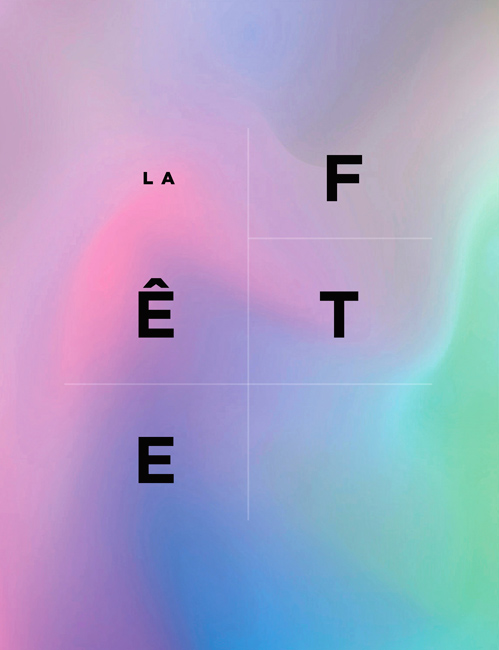
Some of the photographs also feature audio clips easily accessed via the free app Artivive, from which readers can point their smartphones at a page marked with a ◊ symbol. Using this accessible technology, we are brought into some images surrounded by sound. With La Fête, we hold in our hands a gateway to feelings captured in photographs thoughtfully curated into an experience that is heightened by our shared pandemic past and present. The ache for collapsing social distances is eased through the experience of turning each page. The glittering iridescent cover is an enticement in itself – reminiscent of disco-ball décor, dance-floor light flares, and big-time nightlife sensuality.
Each of the first hundred pages features a photograph. Most are paired with another image on the facing page; some images leak over the inside seams of the book; other pages feature more than two images. We are taken on a journey of party places and people through documentary, portraiture, and candid photography. But these are not the parties of the rich and famous: they seem relatable, attainable, accessible. Drawn from a call for Brazilian and Quebec artists, the collection forms clouds of affective conversations that are enacted and engaged among groupings of photographs that cross time, space, and place. There are party and reverie at play in their assembly that pull on our memories, longing, and fear of missing out. Images are loosely grouped together to take us before, during, and after the party in public and private spheres in the street, the club, and the home.
The showcase begins with François Prost’s After Party series of architectural portraits of nightlife venues set against faded blue daylight skies. One image features a one-storey white farm-like building with W-shaped beams, barred port windows, and a slanted black roof that points to the “Le Valentino bar club” sign on top of it. Red and white streamer-like accents scream from the capitalized “Le Valentino” against a clear blue sky. The neon of “bar club” underneath is unlit, the whitewashed exterior of the building reflects the sun, and shadows and highlights cover it plainly.
Like the other images in this section, this photograph shows a daytime version of a night spot without comment: a portrait of a place used at night now wide awake in the sunlight. The facing photograph is an image of a venue called “Must,” a one-storey white-cement flat-roofed building with a dusty-rose awning over a glass-windowed hallway. The walls are streaked with dirt and the white sign that spells out “Must” in capital letters underscores an eighties vibe, as does its capitalized italic arcade font with red, blue, and white digital spots as the arms of the “U.” The muted blue-and-pink sky could be almost dusk or just past dawn. The images in this grouping seem rural, discothèques housed in farm-like settings and buildings, their signage the only clue that they might be the site for a party.
Each building is set in the centre of its frame, with an expanse of road, gravel parking lot, or field in the foreground and sky as background. These pictures set the stage and context for the rest of the book, where the people are. The last image in this grouping is of a building that looks like a school with a rainbow stretched across its face and “L’arc en ciel” spelled out over top, evocative of Quebec’s pandemic slogan “Ça va bien aller,” a reminder that it will get better when it’s safe to party.
We pass through colourful portraits by João Farkas of masked and hooded figures that are captivating and unsettling. We continue through a vast array of posed and impromptu people-packed scenes that feature street dancing, crowd surfing, club kissing, and sparkler holding. A nighttime view of shoulder-toshoulder in-the-street celebrations of Salvador Fest are captured by Esperança Gadelha and speak to the text message image by Géraldine Martin that says “J’ai pas quitté le dancfloor dans ma tête je danse sur Rihanna il est 11h je suis au bureau.” There are also snapped details of specific environments: a black-and-white jumble of shoes in a Montreal doorway by Katya Konioukhova; candle-lit cakes set amidst a table setting, from Delphine Egesborg’s 1979 family archive; grey and red duct-taped stilettos on someone’s feet by Victor Luque; and a sleeping child stretched out on a couch in a red Batman onesie by Frank Desgagnés. This image is paired with another by Desgagnés of someone passed out face down, arms outstretched, on an open sleeping bag on top of a white car that is parked among camping tents in daytime, with a bucolic scene of trees and hills extending into a blue sky horizon peppered with white fluffy clouds. After-the-party sites marked by the residue and absence of people end this section of La Fête.
Video stills from Cao Guimarães and Rivane Neuenschwander show close-up shots of individual ants engaging with colourful confetti. Audio complements these scenes as we wonder whether these ants are the clean-up crew or staging their own party. Finally, André Giesemann and Daniel Schulz capture German bars, clubs, and dance halls littered with the remnants of celebrations. Harshly lit by post-last-call overhead fluorescent lighting, these venue photographs end La Fête’s showcase how it started: without people, but with their presence.
La Fête also features a series of Internet search collage screenshots by Jean-François Prost that combine text and images of party-related culture and protest. These screen grabs of partial excerpts of newspaper articles, YouTube video stills, web journalism, archival posters, performance documentation, and protest photography range from the provocative, political, and innocuous to the historical, performative, and overtly racist. It is unclear why one racist image that reproduces harm is used here, as the context of the collage it is featured in offers no critique and gives no reason. The book includes essays presented in their original language and translated into French, English, and Portuguese. Hélène Matte’s Calendar of No Tomorrows is an evocative temporal series of poems that induce sex, sweat, party culture, apathy, and Christian symbology.
In the closing essay, Adriana de Oliveira and Bernard Schütze examine two examples of Brazilian party subcultures, noting that events presented by the São Paulo-based women-run activist collective Mamba Negra and popular fluxo street parties, with their spatial guerrilla tactics, affordability, mobility, and spontaneity, challenge neoliberalism and the far-right authoritarianist Bolsonaro regime. They describe how “the ungovernability of the self-organized party resides in the desire and capacity not to be crushed, silenced, regulated, or legislated out of existence.”
This essay lends context and meaning to some of the images in La Fête and underscores the potential political vibrancy that the book encounters. Its placement as a conclusion is ideal; like memories of parties past, we can look back on the photographs we’ve experienced here and see them in new ways in the hope that we’ll revisit these party places and people and the feelings that they summon again and again.
Dayna McLeod is a queer video and performance artist. She recently completed a PhD in humanities at the Centre for Interdisciplinary Studies in Society and Culture at Concordia University. Her artistic and theoretical research focuses on media representations of sexuality, queer identity, and how bodies marked female are often perceived as public property.
[ Complete issue, in print and digital version, available here: Ciel variable 118 – Exhibiting Photography ]