
[Fall 2026]
Thematic Introduction
By Jérôme Delgado
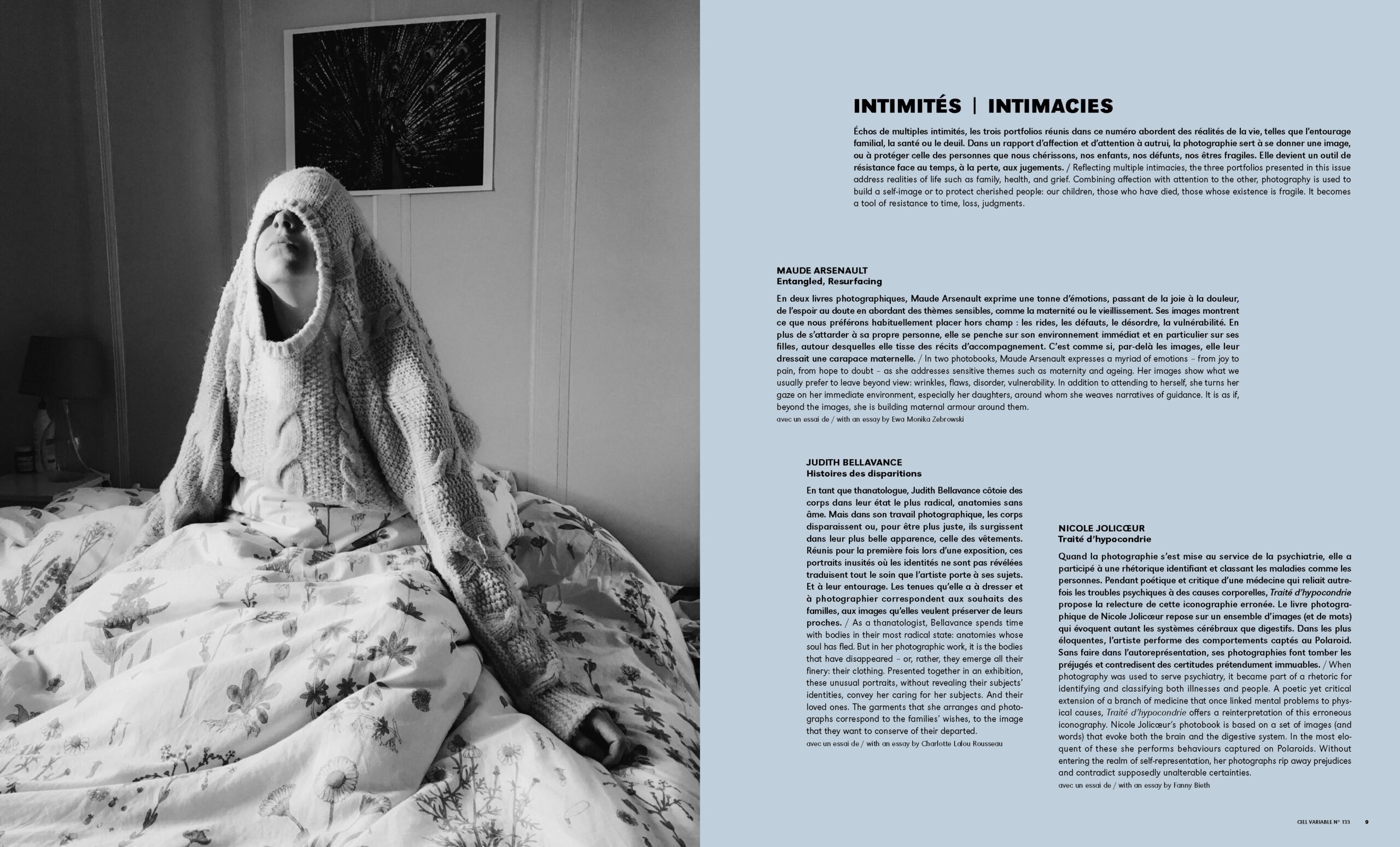
Reflecting multiple intimacies, the three portfolios presented in this issue address realities of life such as family, health, and grief. Combining affection with attention to the other, photography is used to build a self-image or to protect cherished people: our children, those who have died, those whose existence is fragile. It becomes a tool of resistance to time, loss, judgments.
MAUDE ARSENAULT
Entangled, Resurfacing
In two photobooks, Maude Arsenault expresses a myriad of emotions – from joy to pain, from hope to doubt – as she addresses sensitive themes such as maternity and ageing. Her images show what we usually prefer to leave beyond view: wrinkles, flaws, disorder, vulnerability. In addition to attending to herself, she turns her gaze on her immediate environment, especially her daughters, around whom she weaves narratives of guidance. It is as if, beyond the images, she is building maternal armour around them.
with an essay by Ewa Monika Zebrowski
JUDITH BELLAVANCE
Histoires de disparitions
As a thanatologist, Bellavance spends time with bodies in their most radical state: anatomies whose soul has fled. But in her photographic work, it is the bodies that have disappeared – or, rather, they emerge all their finery: their clothing. Presented together in an exhibition, these unusual portraits, without revealing their subjects’ identities, convey her caring for her subjects. And their loved ones. The garments that she arranges and photographs correspond to the families’ wishes, to the image that they want to conserve of their departed.
with an essay by Charlotte Lalou Rousseau
NICOLE JOLICOEUR
Traité d’hypocondrie
When photography was used to serve psychiatry, it became part of a rhetoric for identifying and classifying both illnesses and people. A poetic yet critical extension of a branch of medicine that once linked mental problems to physical causes, Traité d’hypocondrie offers a reinterpretation of this erroneous iconography. Nicole Jolicoeur’s photobook is based on a set of images (and words) that evoke both the brain and the digestive system. In the most eloquent of these she performs behaviours captured on Polaroids. Without entering the realm of self-representation, her photographs rip away prejudices and contradict supposedly unalterable certainties.
with an essay by Fanny Bieth
[ Numéro complet, en version papier et numérique, disponible ici : Ciel variable 133 – INTIMACIES ]
[ L’article complet en version numérique est disponible ici : Éditorial + Introduction]