
[Fall 2026]
Images of Resistance
By Jérôme Delgado
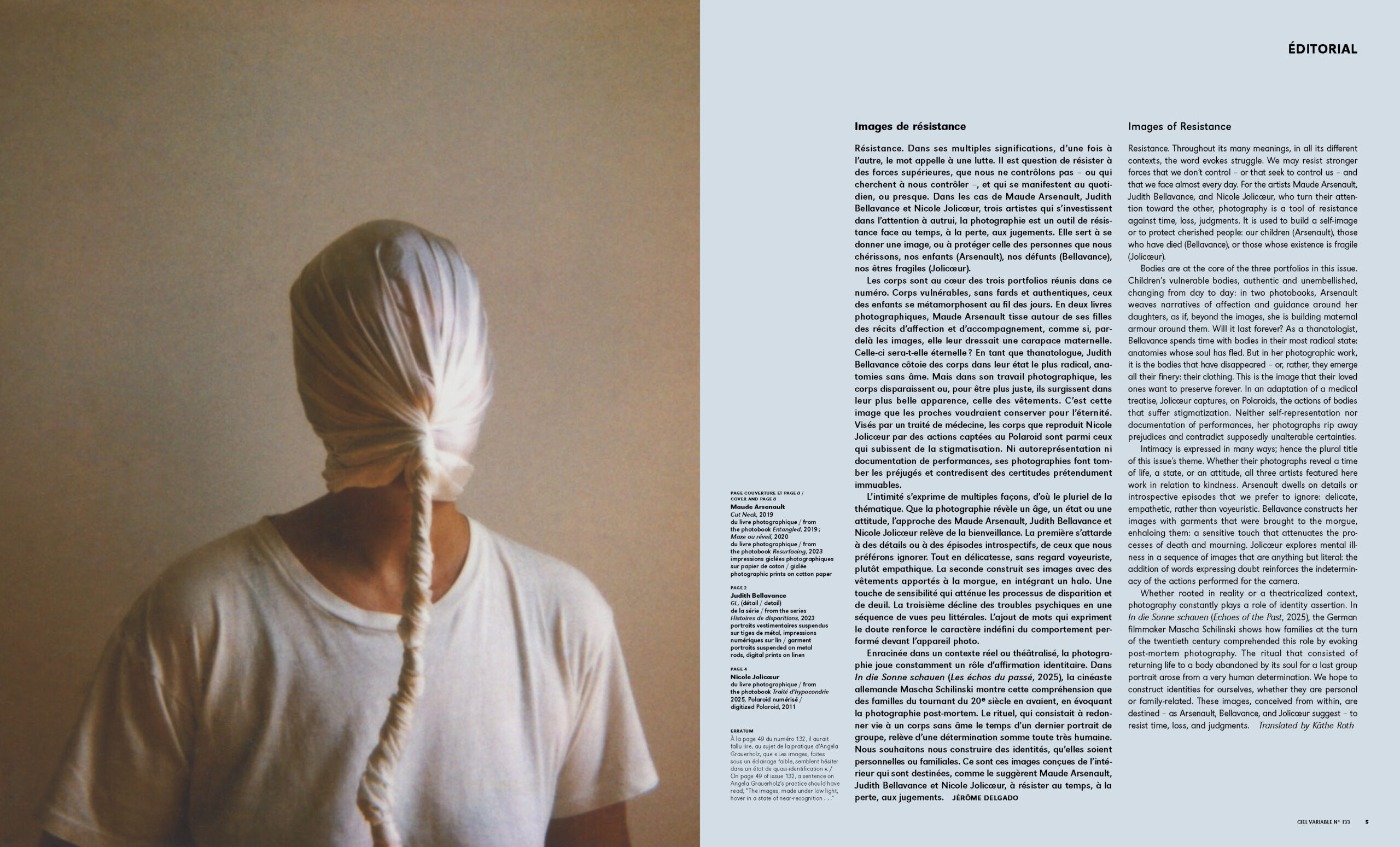
Resistance. Throughout its many meanings, in all its different contexts, the word evokes struggle. We may resist stronger forces that we don’t control – or that seek to control us – and that we face almost every day. For the artists Maude Arsenault, Judith Bellavance, and Nicole Jolicoeur, who turn their attention toward the other, photography is a tool of resistance against time, loss, judgments. It is used to build a self-image or to protect cherished people: our children (Arsenault), those who have died (Bellavance), or those whose existence is fragile (Jolicoeur).
Bodies are at the core of the three portfolios in this issue. Children’s vulnerable bodies, authentic and unembellished, changing from day to day: in two photobooks, Arsenault weaves narratives of affection and guidance around her daughters, as if, beyond the images, she is building maternal armour around them. Will it last forever? As a thanatologist, Bellavance spends time with bodies in their most radical state: anatomies whose soul has fled. But in her photographic work, it is the bodies that have disappeared – or, rather, they emerge all their finery: their clothing. This is the image that their loved ones want to preserve forever. In an adaptation of a medical treatise, Jolicoeur captures, on Polaroids, the actions of bodies that suffer stigmatization. Neither self-representation nor documentation of performances, her photographs rip away prejudices and contradict supposedly unalterable certainties.
Intimacy is expressed in many ways; hence the plural title of this issue’s theme. Whether their photographs reveal a time of life, a state, or an attitude, all three artists featured here work in relation to kindness. Arsenault dwells on details or introspective episodes that we prefer to ignore: delicate, empathetic, rather than voyeuristic. Bellavance constructs her images with garments that were brought to the morgue, enhaloing them: a sensitive touch that attenuates the processes of death and mourning. Jolicoeur explores mental illness in a sequence of images that are anything but literal: the addition of words expressing doubt reinforces the indeterminacy of the actions performed for the camera.
Whether rooted in reality or a theatricalized context, photography constantly plays a role of identity assertion. In In die Sonne schauen (Echoes of the Past, 2025), the German filmmaker Mascha Schilinski shows how families at the turn of the twentieth century comprehended this role by evoking post-mortem photography. The ritual that consisted of returning life to a body abandoned by its soul for a last group portrait arose from a very human determination. We hope to construct identities for ourselves, whether they are personal or family-related. These images, conceived from within, are destined – as Arsenault, Bellavance, and Jolicoeur suggest – to resist time, loss, and judgments. Translated by Käthe Roth
[ Complete issue, in print and digital version, available here: Ciel variable 133 – INTIMACIES ]
[ Article in digital version available here: Editorial + Introduction ]