

[Fall 2021]
Alejandro G. Iñárritu, Carne y Arena
By Jean Gagnon
Arsenal art contemporain
17.03.2021 — 15.08.2021
It has long been possible to experience virtual reality works in Montreal,1 and in spring 2021 a “must-see”2 was Carne y Arena (Virtually Present, Physically Invisible) (2017) by Oscar-winning filmmaker Alejandro G. Iñárritu.3 The presentation in Montreal was thanks to the efforts of Myriam Achard of Centre PHI, who had seen it at the Cannes Film Festival in 2017. That year, the film received a Special Oscar for “exceptional storytelling experience.” But Iñárritu’s work at Arsenal is even more ingenious, for his installation cannot be summarized simply in narration, and the experience is not simply virtual.
As we wait our turn to enter the first gallery,4 we have the time to look at a wall of undulating, rusted sheet metal. A wall text explains that this is a part of the border wall between Mexico and the United States. This type of panel was used originally in Vietnam by the American army to encircle landing zones for helicopters. Recycled from the military-imperialist complex, this artefact represents both the domination and the protectionism of an arrogant, but frightened, United States.
The first gallery that we enter is a replica of a detention centre that migrants call la hielera (the ice house) because it is so cold after the crossing of the burninghot desert. We take off our shoes and socks and, alone in the room, barefoot, we wait, feeling cold and uncomfortable. Around us, torn knapsacks and worn-out shoes are clues to the migrants with whom we can identify through our own discomfort. An alarm blares and a flashing red light indicates the door to take.
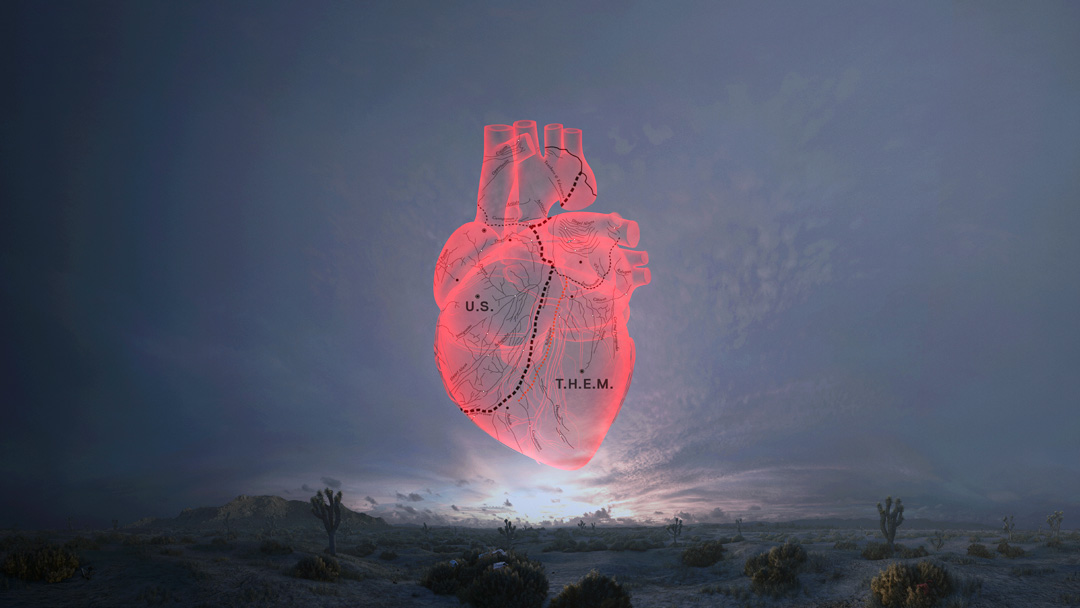
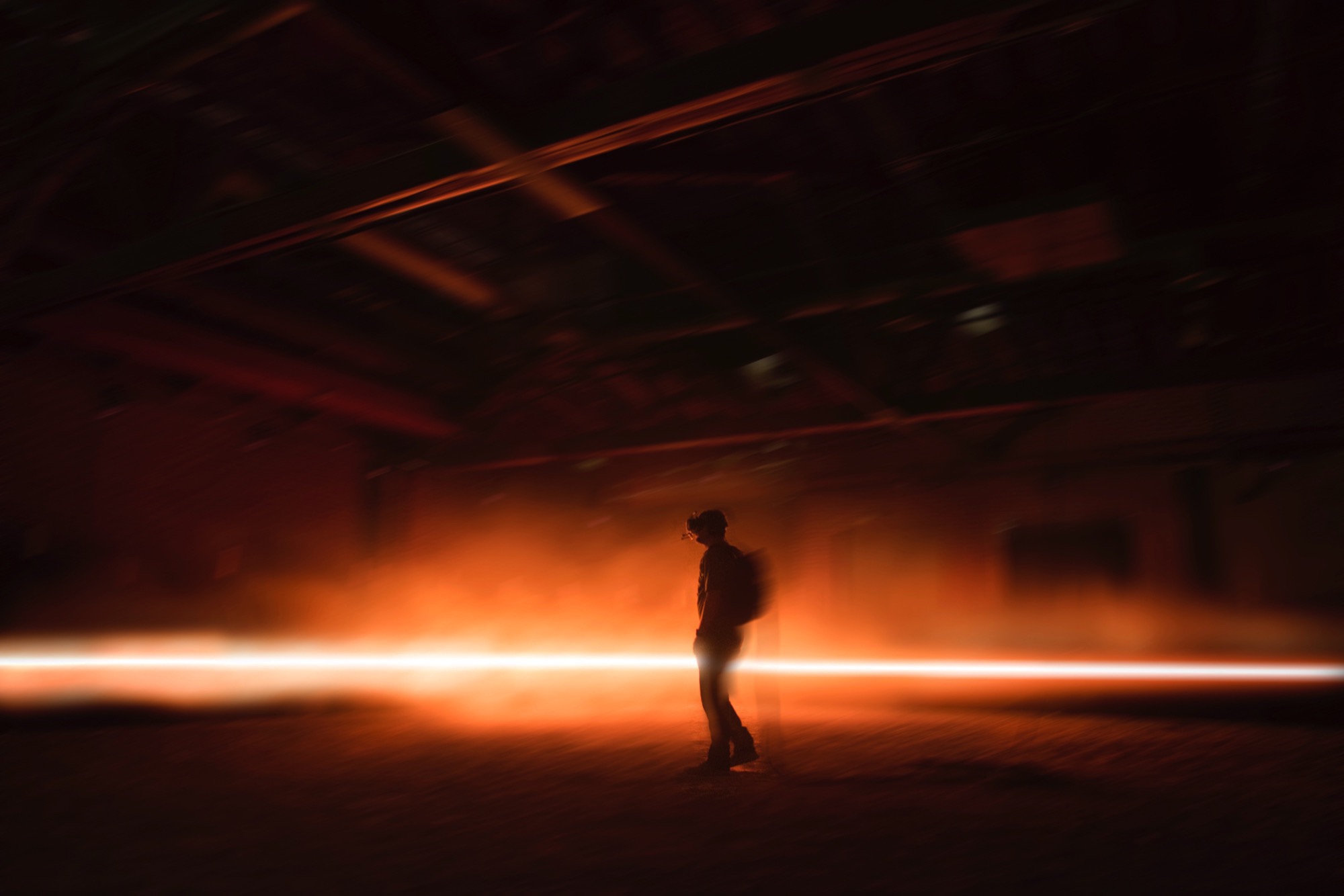
The immersive experience itself takes place in that gallery, where we walk on cold, pebbly sand. A gallery worker helps us put on a virtual reality mask, earphones, and a knapsack. It begins: it’s dawn in a desert landscape. In the half-light, we can hear the voices of men, women, and children speaking Spanish. They are barely audible as they advance and hide behind bushes. A helicopter patters its blades, flies over the group, and aims its blinding spotlight. Two cars emerge, and armed border guards get out, accompanied by their dogs. Soldiers and migrants scatter and shout, confusion reigns around us, and we feel the chaos, even panic. Suddenly, everything goes quiet. We notice people sitting around a picnic table in the centre of which a boat made of modelling clay is tipping over. Castaways get out and disappear beneath the surface of the table. We can’t help but think of migrants attempting the crossing of the Mediterranean in leaky boats, often with a tragic ending. Then, suddenly, the nightmarish border returns. The tone rises once again; the border guards are nervous. We no longer know where to turn if we want to follow everything that is happening around us. The most traumatic moment occurs when one of the armed men trains his assault rifle on us. This is how the virtual journey ends. The place is once again a desert; the sun is rising in the distance. During all this time, disembodied, we are among the migrants but not one of them; we can’t interact with them, we are a bodiless phantom.
Once the harness is removed, we leave this gallery and put our shoes back on. The following room presents a series of video portraits of people whose avatars we have just spent time with. Texts superimposed on the faces give a brief history of each: country of origin, reasons for migration, current situation of the undocumented immigrant, motivations, and so on.
In La Presse, Myriam Achard admitted, “It was the first time I cried wearing a virtual reality helmet.” In Le Devoir, she said that she was overwhelmed by this experience, “in which emotion takes over from the intellect.” “Feeling” predominates; tears become gauges of authenticity. So, are we to believe that we are exonerated of thinking, analyzing, and understanding?
Filmmakers working in the heart of Hollywood plod along with the impression of reality. Movies run on identifications and projections in order to “bring alive” emotions or inspire empathy. If it were only ten minutes of immersive film, Carne y Arena would be just a new version of the cinematographic cocoon in which viewers can cuddle up to “feel.” Here, as in cinema, the viewer is only a witness, never a protagonist.
Iñárritu was more astute: he didn’t take the easy way out. His immersive film articulates something other than simulated reality. The scene in which a shipwrecked boat is animated is an intervention that breaks the immersive unity and demands a hermeneutic effort. This short scene broadens the work’s discourse. Beyond their immediate feelings, viewers are forced to interpret what is before them. It is when they’re in the gallery, looking at the portraits of the migrants with bits and pieces of their history, that true empathy is born, for there’s no way to feel attachment to avatars – only to faces.
Carne y Arena questions art’s effectiveness, role, and power to generate change by oscillating between emotion and intellect, the sensory and the intelligible. Viewers take in the experiential shock of the immersive situation but must articulate the elements of the work in order to produce an interpretation of it. Because it is virtual reality, it seems that one can be content with the sensory. Virtual reality is a good match for our individualistic times – it’s a solitary pleasure – in which we are attentive to what we feel, whereas a bit of intellectual distancing would enable us to understand and to act. Translated by Käthe Roth
1 Centre PHI has made this a specialty in recent times, and the galleries Art Mûr and Ellephant present it occasionally.
2 Marc Cassivi, La Presse, October 16, 2020.
3 He has directed, among others, Amores perros (2000), Babel (2006), Biutiful (2010) Birdman (2014), and The Revenant (2015).
4 In Montreal, Carne y Arena allowed three users in three different galleries
to participate in the experience.
5 La Presse, October 16, 2020.
6 Le Devoir, March 17, 2021.
Jean Gagnon, who holds a PhD, is an exhibition curator, art critic, and independent cultural manager, after having worked for more than twenty-five years at the National Gallery of Canada, the Daniel Langlois Foundation for Art, Science, and Technology, La Cinémathèque québécoise, and the studio of artist Rafael Lozano-Hemmer. He contributes to art magazines and is a member of the boards of directors of Ciel variable and V/Tape in Toronto.
[ Complete issue, in print and digital version, available here: Ciel variable 118 – Exhibiting Photography ]