
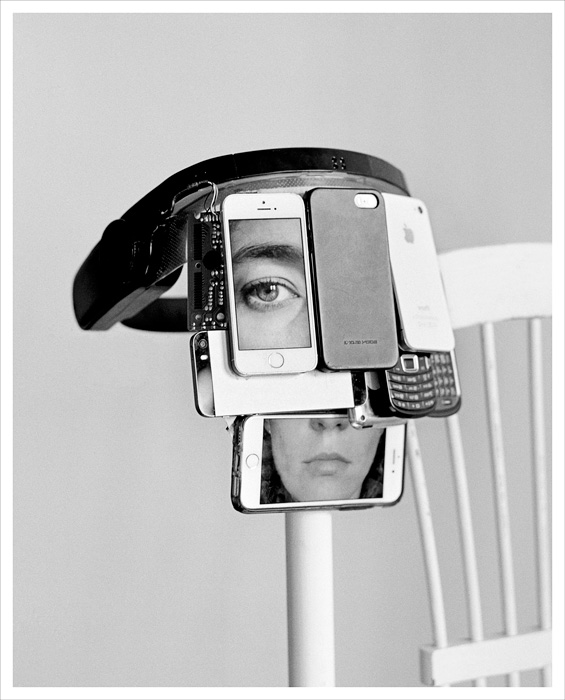
Charlie Doyon, Corps Abstraits, 2021
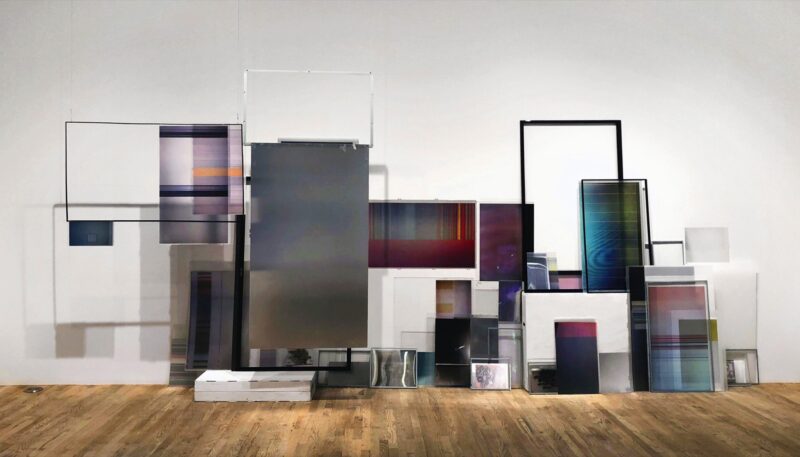
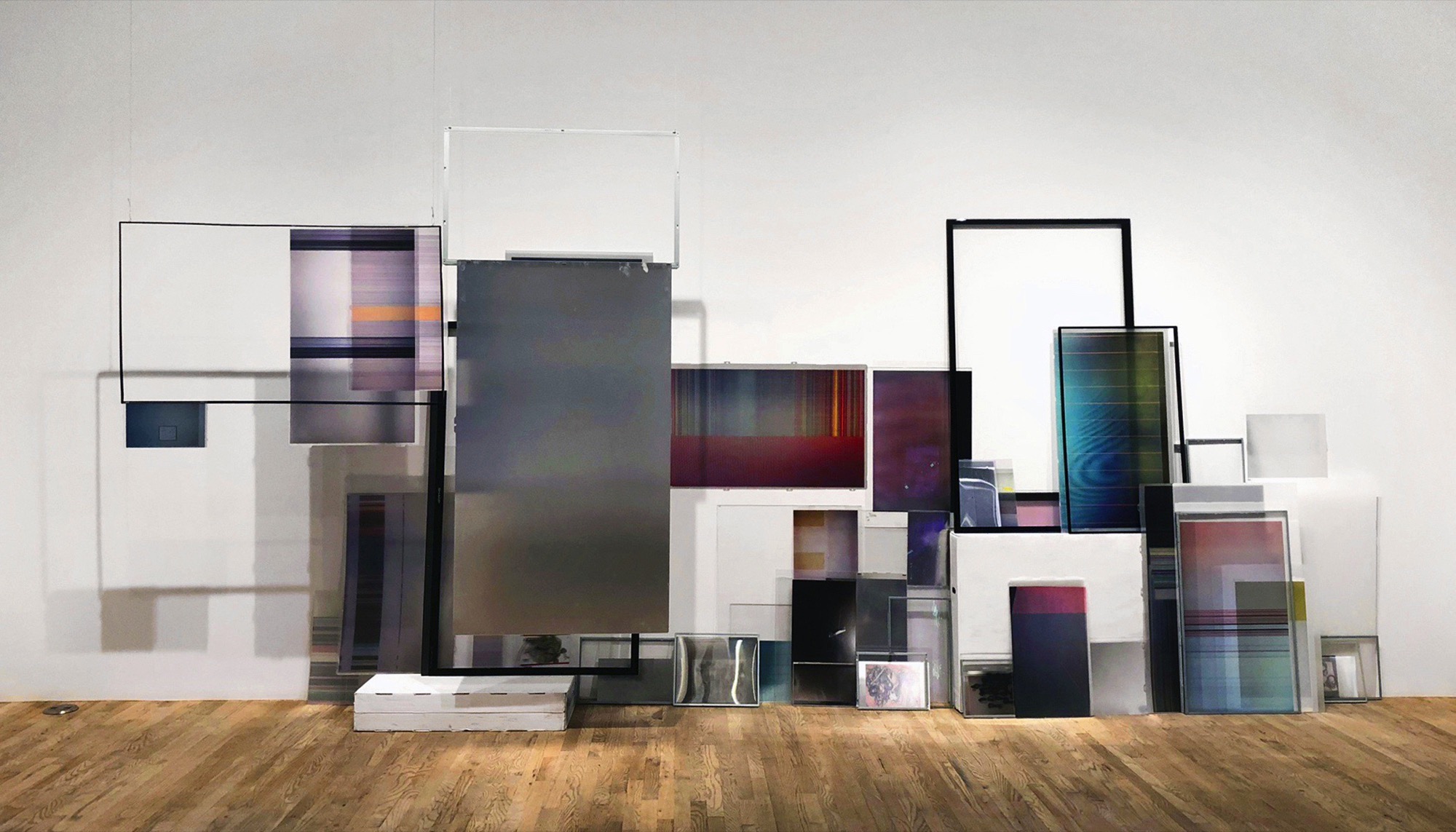
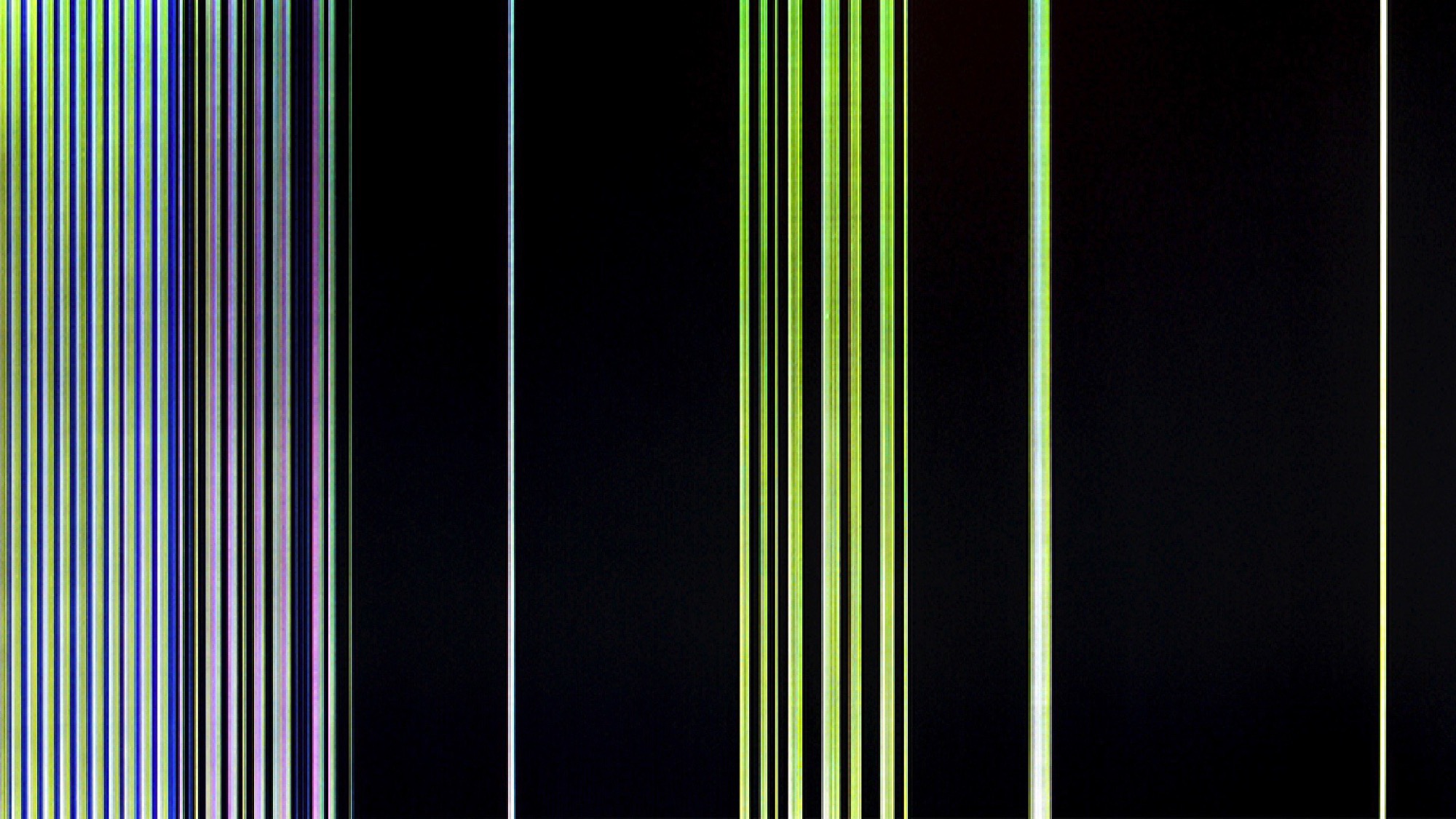
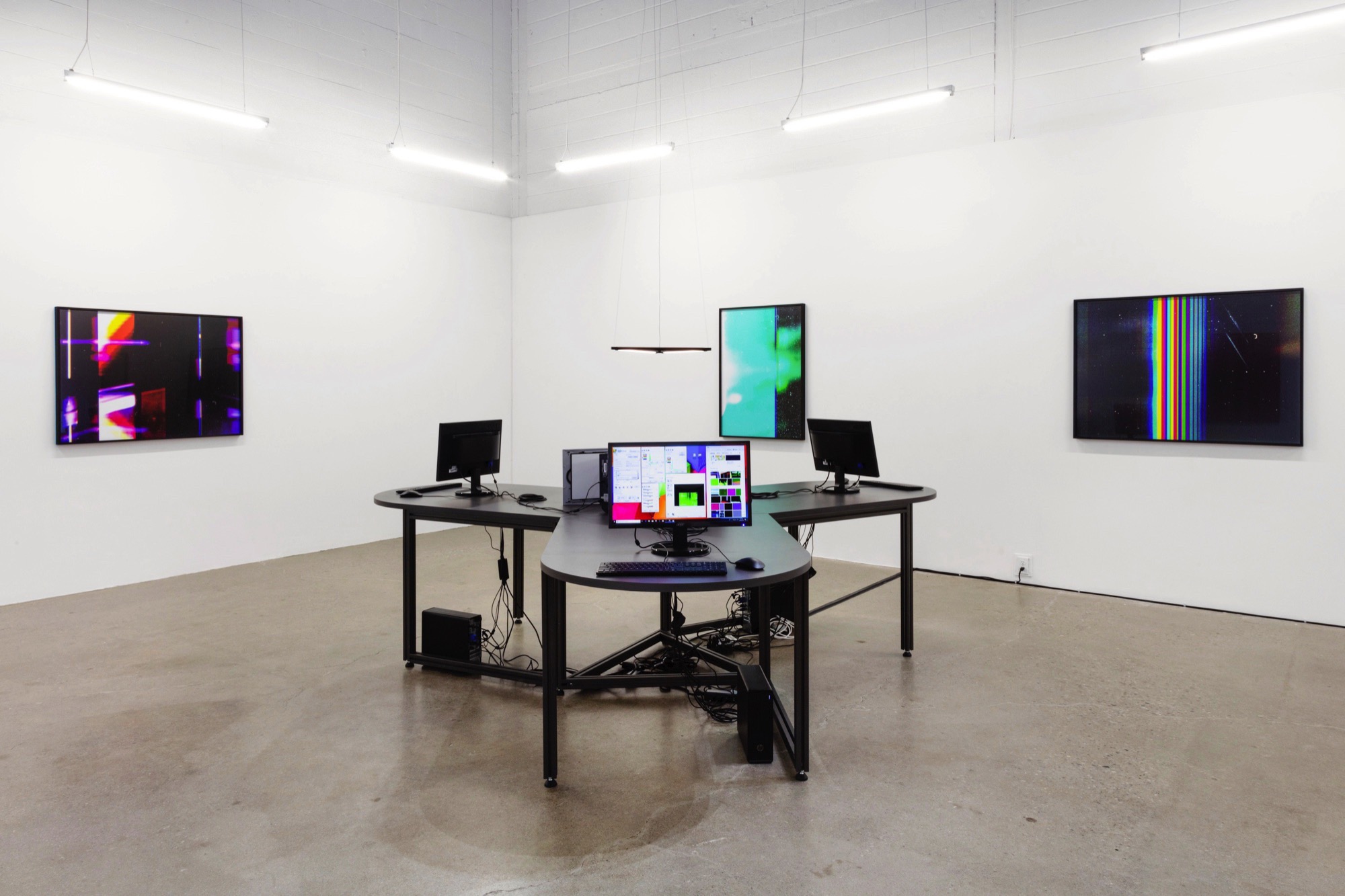
Penelope Umbrico Out of Order / Bad Display, 2018 permission de / courtesy of Postmasters Gallery
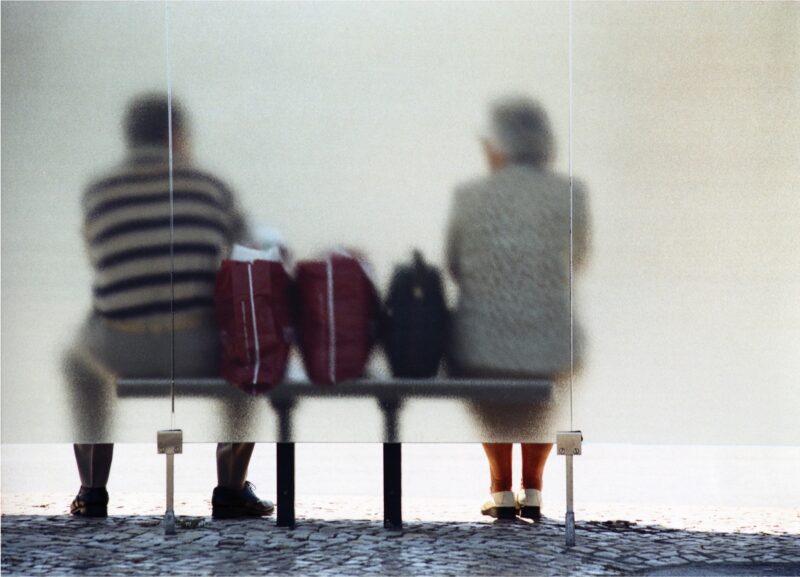
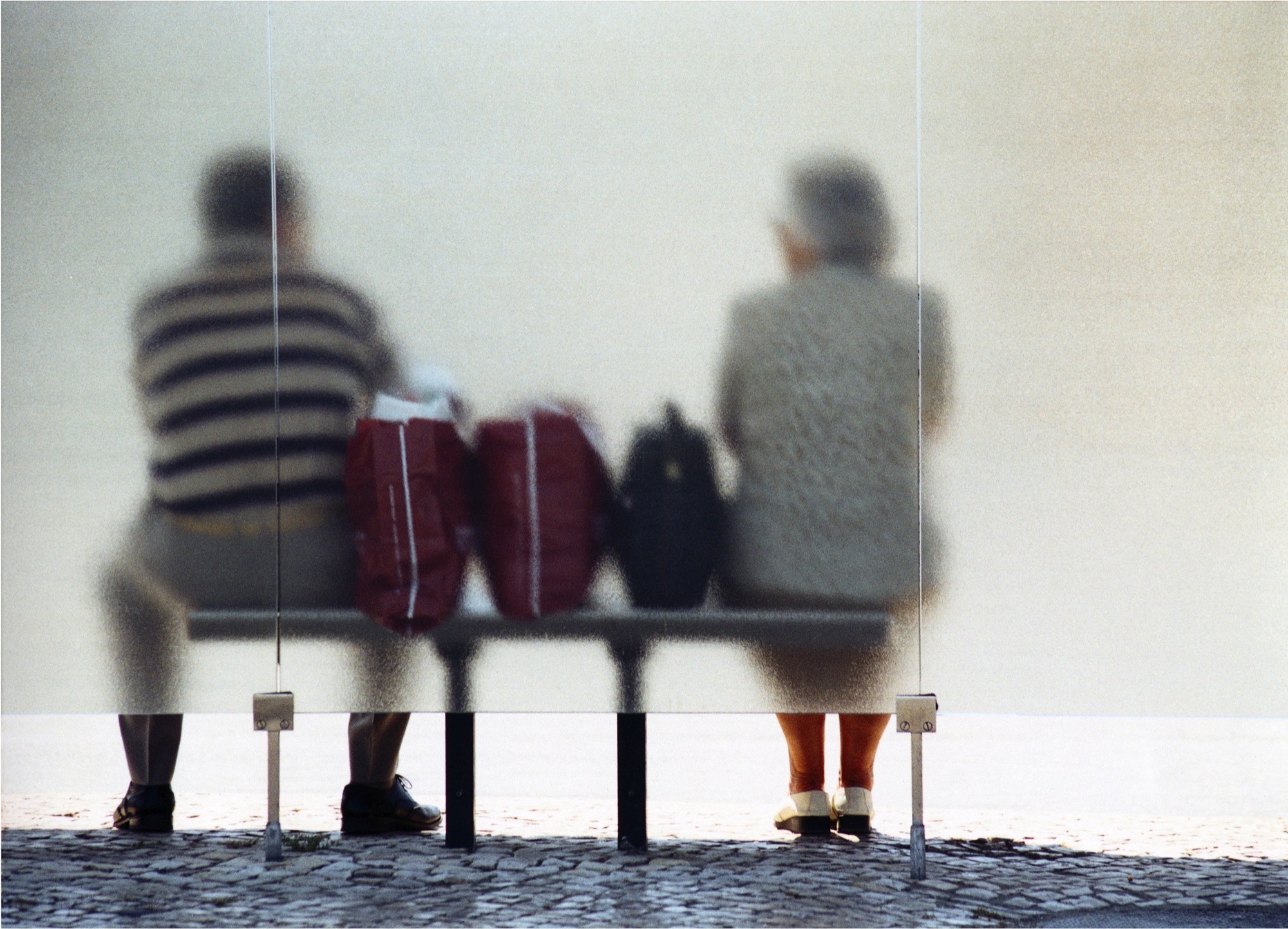
Jean Baudrillard
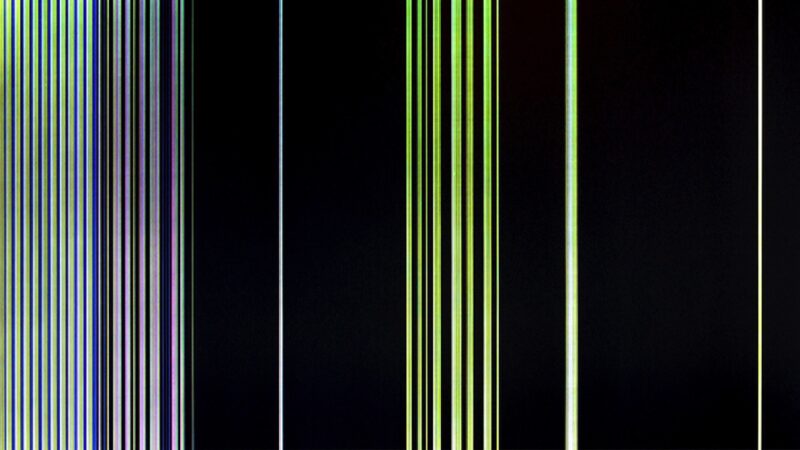
$_57-20.jpg, extrait de Broken Sets / eBay 2007 – en cours / ongoing
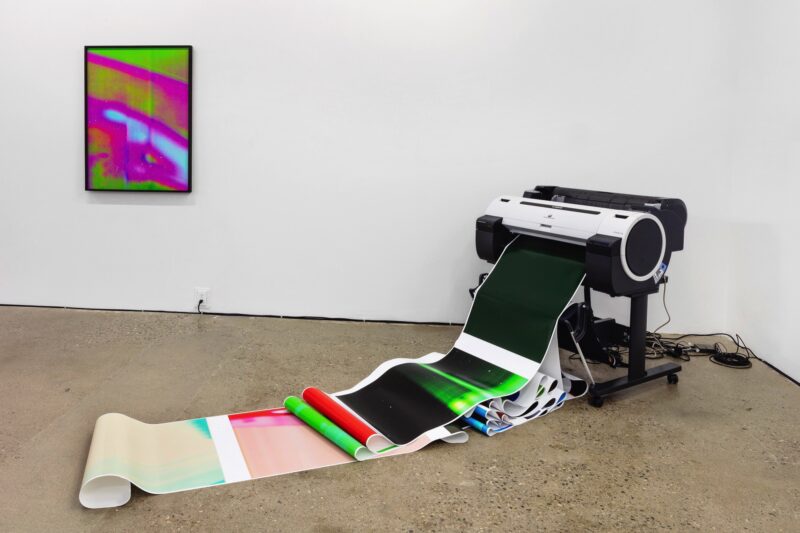
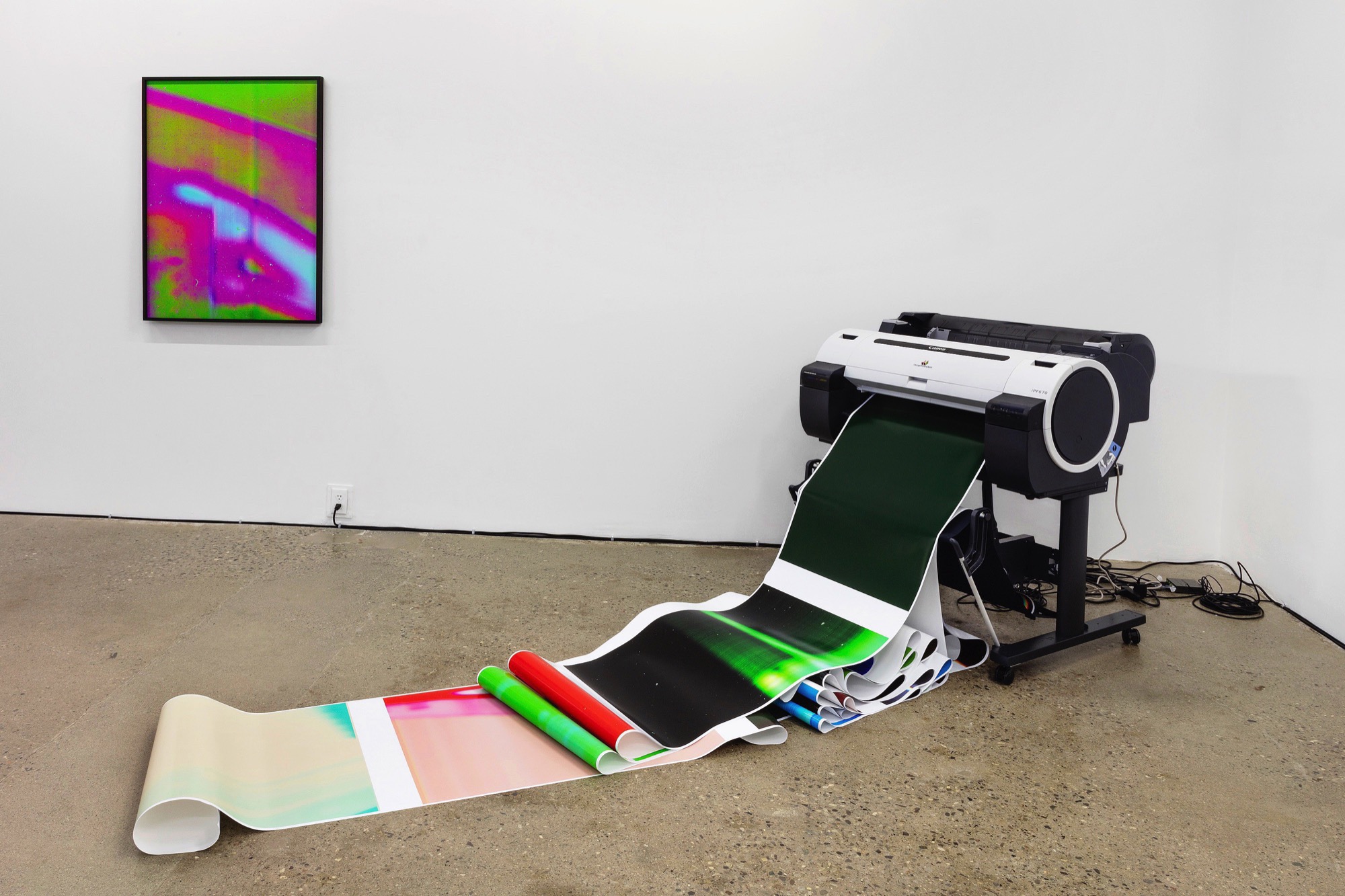
Adam Basanta All We’d Ever Need Is One Another (Trio) 2019, photos : Laura Findley
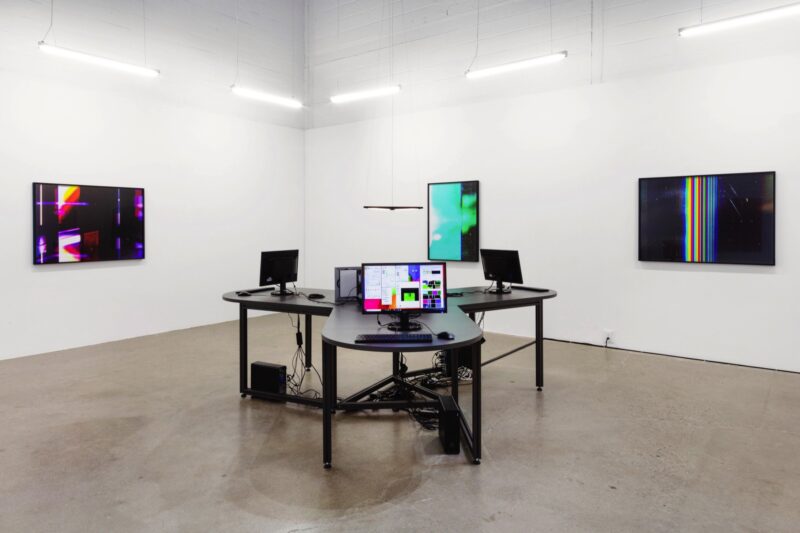
Adam Basanta All We’d Ever Need Is One Another (Trio) 2019, photos : Laura Findley
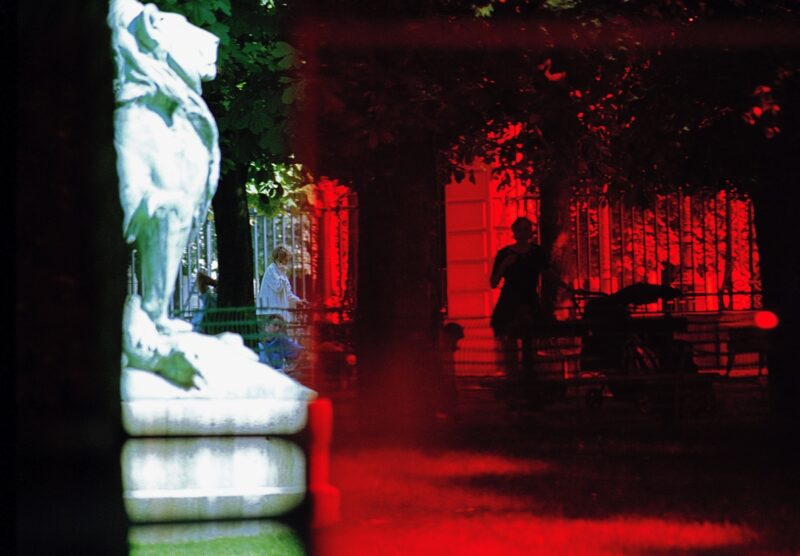
JB411-13 001
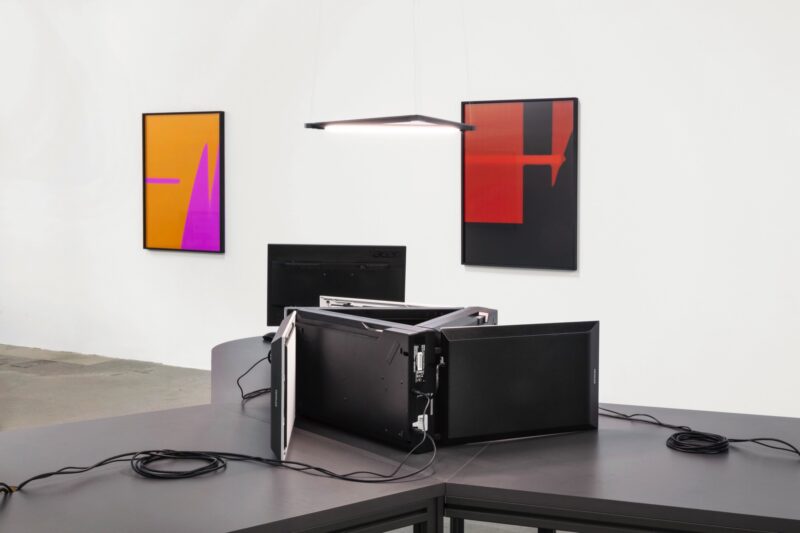
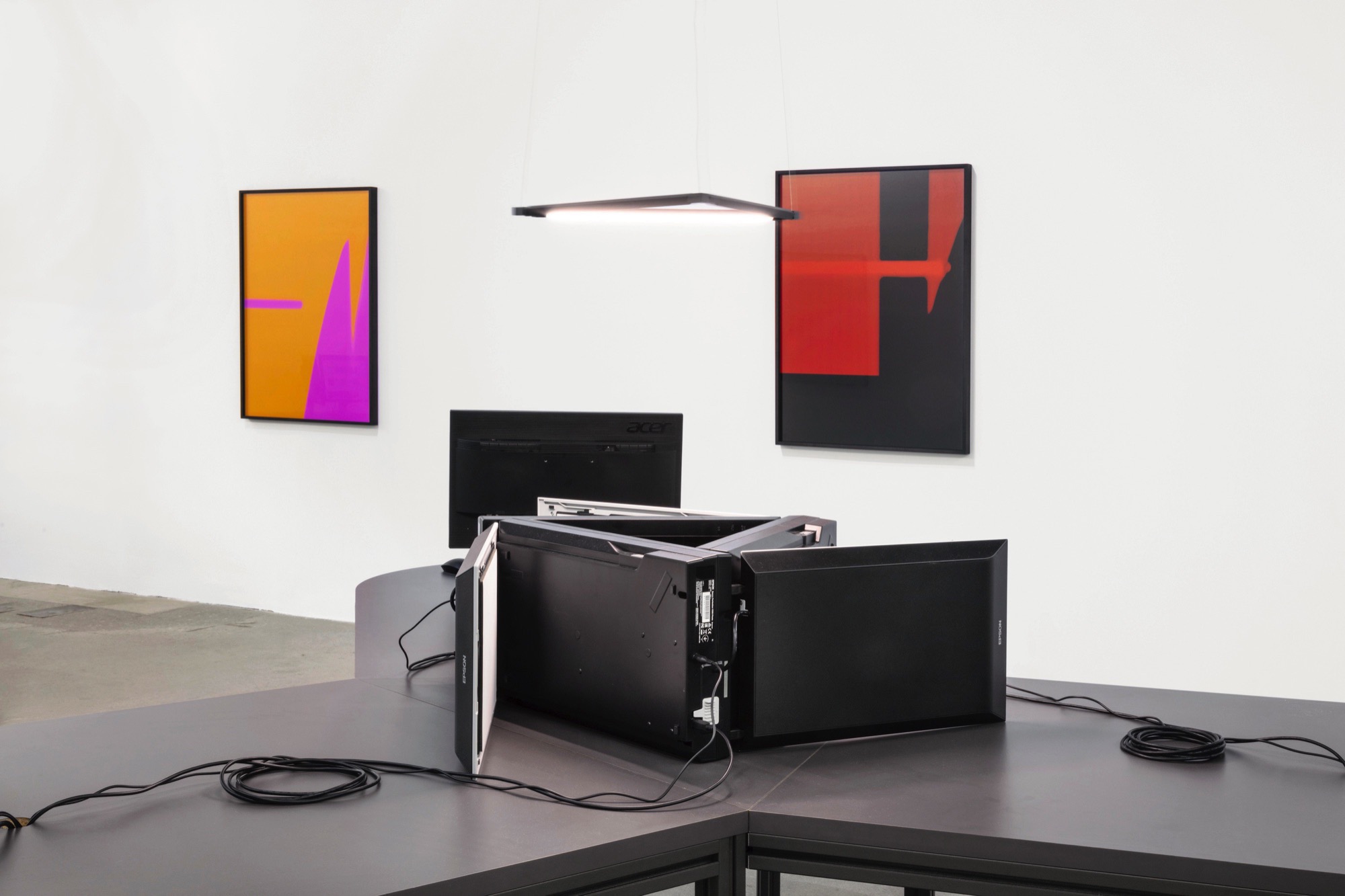
Adam Basanta, All We’d Ever Need Is One Another (Trio), 2019 photos : Laura Findley

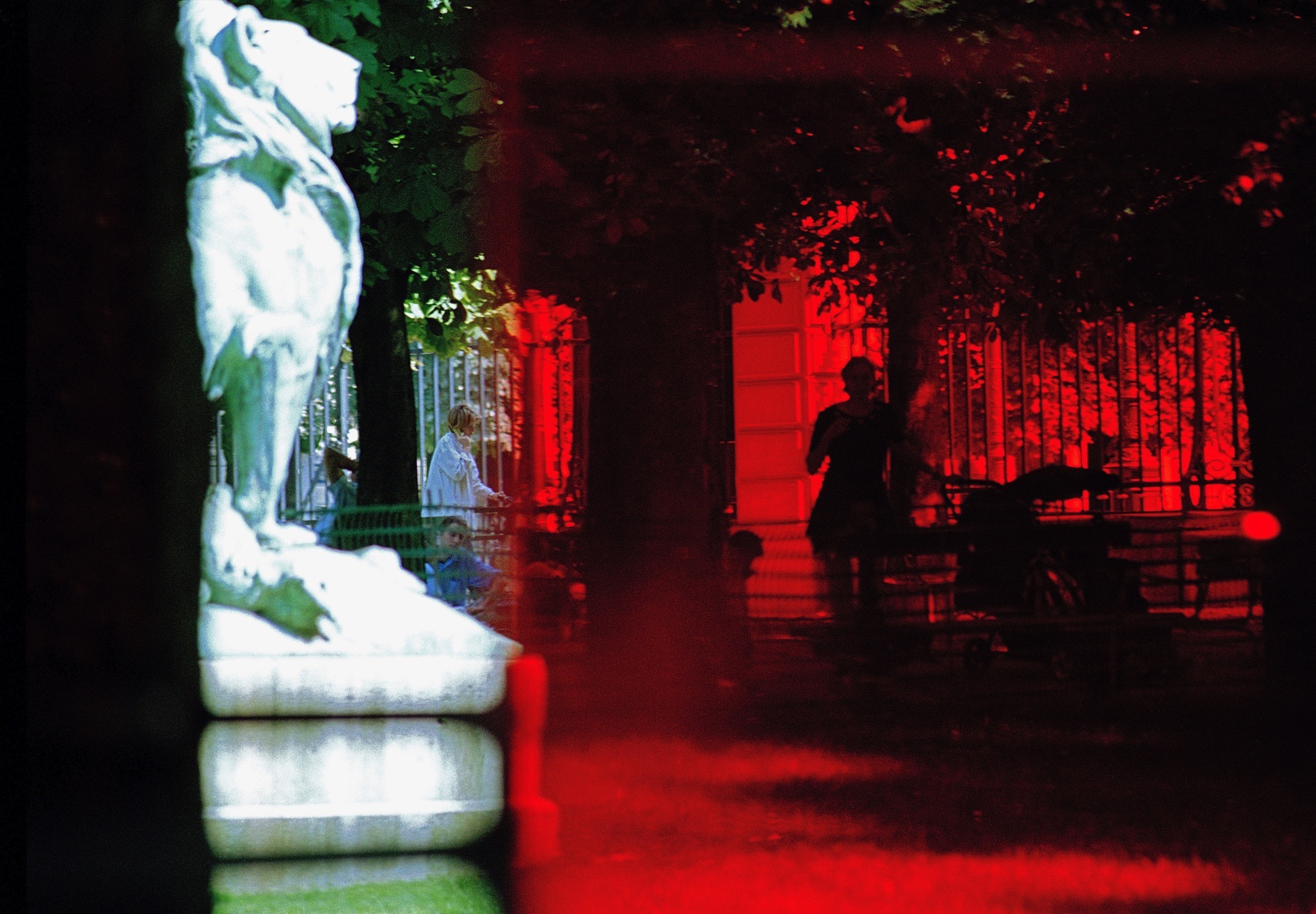
Jean Baudrillard JB356-6a, non daté / undated permission de / courtesy of Marine Baudrillard


[Fall 2021]
The Absence Machine
by Edward Pérez-González
The reflections on screens and on relations between image and reality offered by the philosopher Jean Baudrillard (1929– 2007) in his essay Écran total served as a framework for the staging of the exhibition of the same name, presented by the Centre de design at UQAM1 and organized by a curatorial collective. Projected on the walls, Baudrillard’s photographs physically and conceptually enwrapped the works by the guest artists – Adam Basanta, Penelope Umbrico, Mishka Henner, and Vaseem Bhatti – and by the artists selected through a competition – Charlie Doyon, Clint Enns, and Xuan Ye. These works were intended to challenge the implications for contemporary life of the omnipresence of screens: “No more separation, no more emptiness, no more absence: we enter the screen, the barrier-free virtual image. We enter our life as if entering a screen. We scroll through our own life as a digital stratagem.”2
In our constant desire to invent a stimulating life for ourselves, a life that is conditioned and valorized by the gaze of the other, we unreservedly abandon ourselves to the world of screens. As contemporary people, we can exist only through them, and we pay no mind to what is left out in this process of dehumanization: smell, taste, texture, weight, density, time. Hypnotized, we enter the screen, participating in and subjecting ourselves to the frenetic bombardment of images, including those that we should naturally find shocking: natural catastrophes, scenes of violence, injustice, racism, homophobia, genocide, and so on. We apprehend them as if they were images from feature films, or narrative constructions, or even the remains of a bygone imaginary. By separating us from the real, the screen seems to protect us, shelter us, remove us from the human condition, from what could make us suffer. And so, we live in the time of “de-” – not in the sense of negation or reversal of meaning, nor in the sense of excess, but in the sense of being “outside of.” Desensitization, dehumanization – the search for an out-of-human existence.
The staging of the exhibition is based on the idea of central core and enwrapping. The wrapping is composed of several video projections presenting short sequences in which photographs taken by Baudrillard alternate with excerpts of his writings. One might say that Baudrillard resists the erasure of the subject and the dissolution of singularities by trying, through his photographs, to capture the value of experience, of real life, as an intense event – the value of the “I” that I am – physical body, sensations, and perceptions. His gaze testifies to his sensitivity to the texture of the world as rendered through the photographic image.
Chiaroscuros, reflections, saturated colours: everything he captures reveals his particular attention to the light at a given moment and to a living connection to phenomena – in short, his subjectivity. He seems to use photography to reveal to us that which is unique in us and which, in contrast, the screen dooms to disappearance.
The works that form the core of the exhibition are based on the critical vision of the world of Baudrillard the philosopher and not the artist: a world in which the statement becomes the screen itself. This notion is illustrated very directly – perhaps too directly? – in Charlie Doyon’s Corps abstraits, which presents screens that break up and substitute for the body. We see, in three dimensions, a mask composed of an arrangement of cellphones on which parts of a face are distributed: on one screen an eye, on another the mouth, and so on. This three-dimensional mask is accompanied by large black-and-white analogue prints in which we see the individuals whose faces, as centre of subjectivity, are broken into pieces by other types of screens.
In Penelope Umbrico’s Out of Order/eBay (Broken Screens on Screen and Broken Screens), it is defective screens, deployed both physically and digitally, that are given the right to “speak.” Dismantled translucent layers are suspended, one in front of the other, in the space. In the background is a video montage, in a series of crossfades, of signals on broken screens: vertical colour bars that somehow ironically evoke formalist painting or experimental video. Even moribund, the screen offers something to contemplate.
In Clint Enns’s Internet Vernacular – One Year Project (2004), the “life of the screen” takes a more disturbing turn. To start with, we wonder whose personal diary has provided the 366 photographs covering a large wall and arranged like a calendar (one group of images per month), some placed so high that they are barely visible. Their radical heterogeneity and their utterly unequal degree of interest give us the clue: these photographs were simply chosen from a content-sharing platform – Flickr – as a function of the date inlaid in each image (thus, the day when it was taken), without taking account of the people who produced them or are shown in them. The grouping evokes the process of normalization and de-subjectification that allows the screen to tell its own story. Its life – cannibalizing all lives – becomes the true subject of the work.
Recycling of images available on the Internet is also behind the large-screen video projection by Mishka Henner and Vaseem Bhatti, Energy Goast. This work consists of videos of natural catastrophes – many of them captured by surveillance cameras – that Henner and Bhatti assembled and on which they superimpose, at times, large graphic symbols evoking both weapon sights (thus a connection with the military world) and logos (as if marketing were capturing the rage of the world). Here again, through the accumulation of sequences, decontextualization, and schematization, a disconnected world is shown and scrutinized soullessly.
All of these screens act as “apparatuses,” in the sense attributed to them by the philosopher Giorgio Agamben, overtaking the definition proposed by Foucault, who intended the apparatus as a heterogeneous group of components, discursive or not, always with a concrete strategic function inscribed in a power relationship. Pragmatically, Agamben builds on this concept by listing some examples:
I shall call an apparatus literally anything that has in some way the capacity to capture, orient, determine, intercept, model, control, or secure the gestures, behaviors, opinions, or discourses of living beings. Not only, therefore, prisons, madhouses, the panopticon, schools, confession, factories, disciplines, juridical measures, and so forth (whose connection with power is in a certain sense evident), but also the pen, writing, literature, philosophy, agriculture, cigarettes, navigation, computers, cellular telephones, and – why not – language itself.
It’s my opinion that Adam Basanta’s installation evokes most pointedly the hegemonic presence of screens as apparatuses. Closing the exhibition path, his All We’d Ever Need Is One Another (2019) is composed of three medium-sized digitizers lying on their side and presenting their scanning surfaces to each other, enabling them to mutually digitize each other. A software program – in view – randomly determines the digitization parameters as a function of automatic mouse movements. The digital images, generated apparently fortuitously, are analyzed by a series of machine-learning algorithms that use a database containing images of well-known contemporary artworks.
Through a process of comparison, the algorithm selects images that have an 80 percent resemblance to the works in the database; then, deeming them works of art, it sends them to a website, a Twitter account, and an Instagram account. When the machine recognizes a very close match, the images are automatically reproduced in large format by a printer located in the exhibition space. With this art-making machine, “a factory without workers,” Basanta highlights the contemporary rush to abandon ourselves to the machine, to surrender to it, to slough off what makes us human. One might challenge the artistic status of the images produced – although it would be a sterile, highly charged debate – or simply echo the postulate of the Italian philosopher Dino Formaggio (1973) and consider to be art everything that people call art. Whatever the case, Basanta, through his installation, cynically highlights the interplay between cultural consumption and the economic machinery of art. He uses the screen no longer as a tool of mediation, but as an apparatus of erasure of the real that produces a completely new and autonomous substance. He thus fully inscribes his art in the wake of what Baudrillard stated in Écran total: “Machines produce only machines. . . . At a certain level of machination, of immersion in the virtual machinery, there is no longer a distinction between human and machine: the machine is on both sides of the interface.” Translated by Käthe Roth
1 From May 19 to June 20, 2021
2 Jean Baudrillard, Écran total (Paris: Éditions Galilée, 1997), 200 (our translation).
3 Giorgio Agamben, What Is an Apparatus? And Other Essays, trans. David Kishik and Stefan Pedatella (Stanford: Stanford University Press, 2009), 14.
4 AAdam Basanta, leaflet for All We’d Ever Need
Is One Another (n.d.).
5 Author’s adaptation of “L’arte è tutto ciò che gli uomini chiamano arte,” in Dino Formaggio, L’arte come idea e come esperienza (Brescia: Editrice Morcelliana, 2018), 284 (our translation).
6 Baudrillard, Écran total (our translation).
Edward Pérez-González completed a PhD in architecture based on a postmodern conception of museums, and more specifically on Deleuzian philosophy, in 2013. He has curated exhibitions in Venezuela and Brazil. He is a member of the curatorial laboratory of the Leopoldo Gotuzzo Museum of Art attached to the Universidade Federal de Pelotas, in Brazil, where he is a guest researcher. In recent years, his research has focused on contemporary painting, architectural theory, and exhibition curating.
[ Complete issue, in print and digital version, available here: Ciel variable 118 – Exhibiting Photography ]