

[Winter 2026]
A Passion for Images
by Jacques Doyon
Each of the series presented in this issue bespeaks a passion for images. Assembled by artists and a writer – all of whom are both collectors, archivists, and documentarians – are portraits of British Columbian collectors of contemporary and Indigenous art, archival images that pay tribute to the actions and rituals of those who worked in darkrooms, and a century’s worth of vernacular photographs of women reading. Key to these bodies of work is an emphasis on the gestures, knowledge, and commitment that make culture, promote its dissemination, and allow it to permeate all aspects of society.
In his portraits of collectors, Christos Dikeakos shows the richness and diversity of people devoted to amassing works and objects for pleasure of being in their presence and ensuring their preservation in the collective memory. These portraits, each the result of a unique process, convey the particular idiosyncrasies that connect the individuals to the objects and works that they acquire. Other dimensions of private or institutional collecting are also part of the entire series, including artists’ studios, archival cabinets, and museum galleries, that evoke the thread that runs from creation to appreciation to preservation of cultural works. This idea of an extended notion of collection finds an illustration in the improbable, and utterly remarkable, mass of toys and children’s shoes deposited on the steps of the B.C. Legislative Assembly building in memory of Indigenous children who died at residential schools.
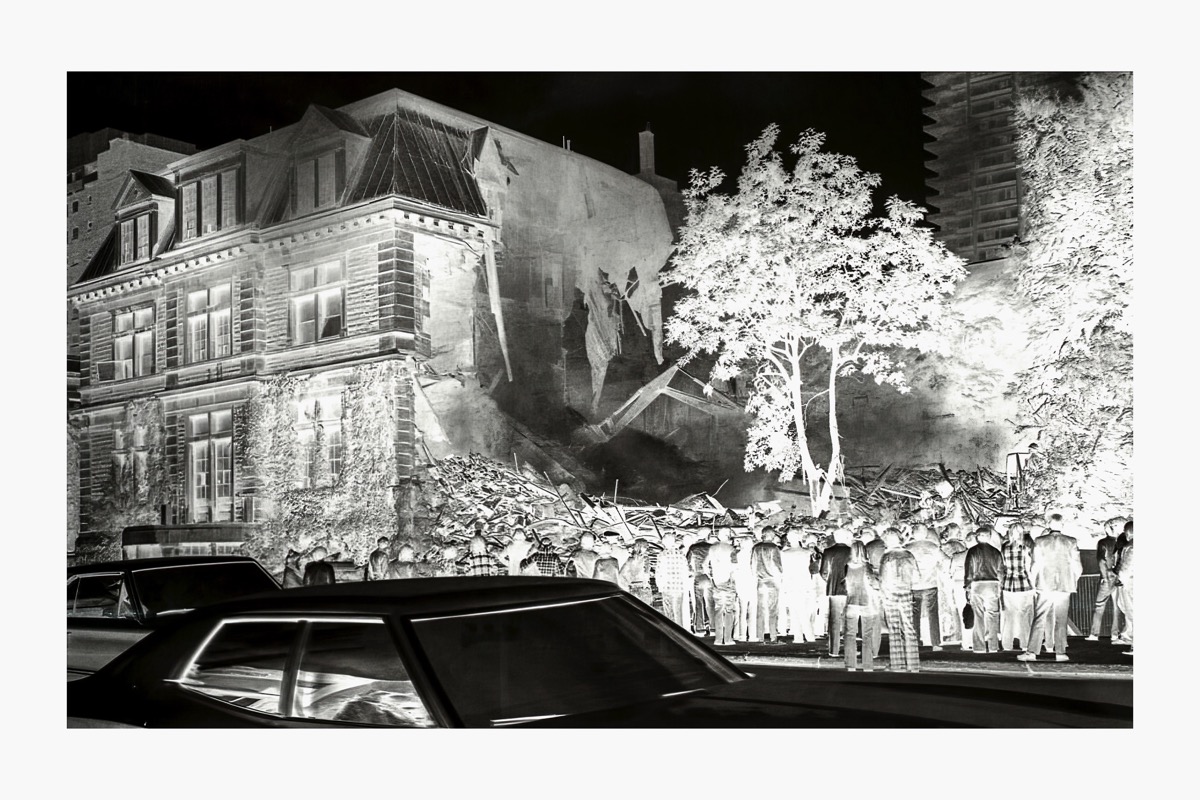
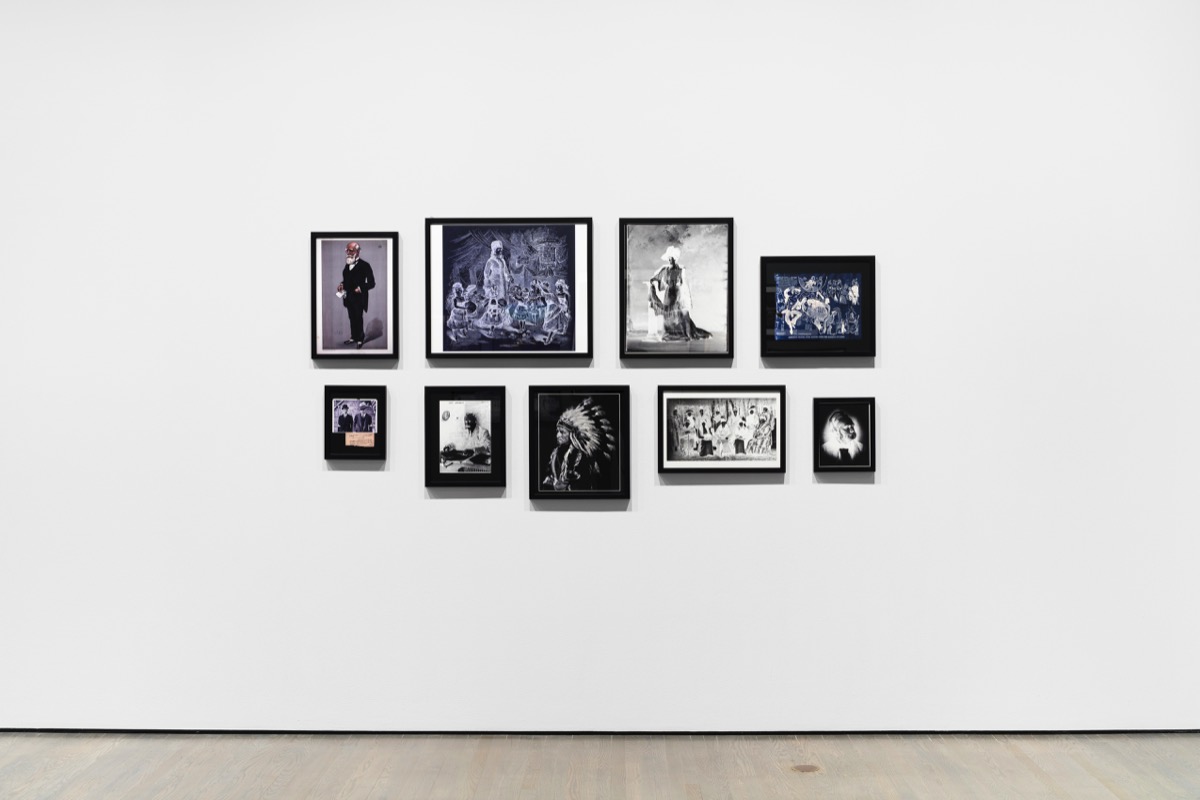
Michel Campeau is an inveterate gleaner and scrutinizer, studious and amused, of the photographic image. He is also an art photographer who has chosen to no longer create images; instead, he brings to light neglected photographs. His latest book features a long series of archival images that combine to form a typology of the gestures and rituals associated with photographic processes in the darkroom. In this sense, he casts a sort of archaeological gaze at an almost-obsolescent image technology and pays tribute to all the players and contributors who practised and promoted it. The gestures are specific and the tone often serious – with humorous scenes sprinkled in – but the book is enhanced by Campeau’s personal narrative that relates the story of his career and, especially, the moments that compelled him to become an artist.
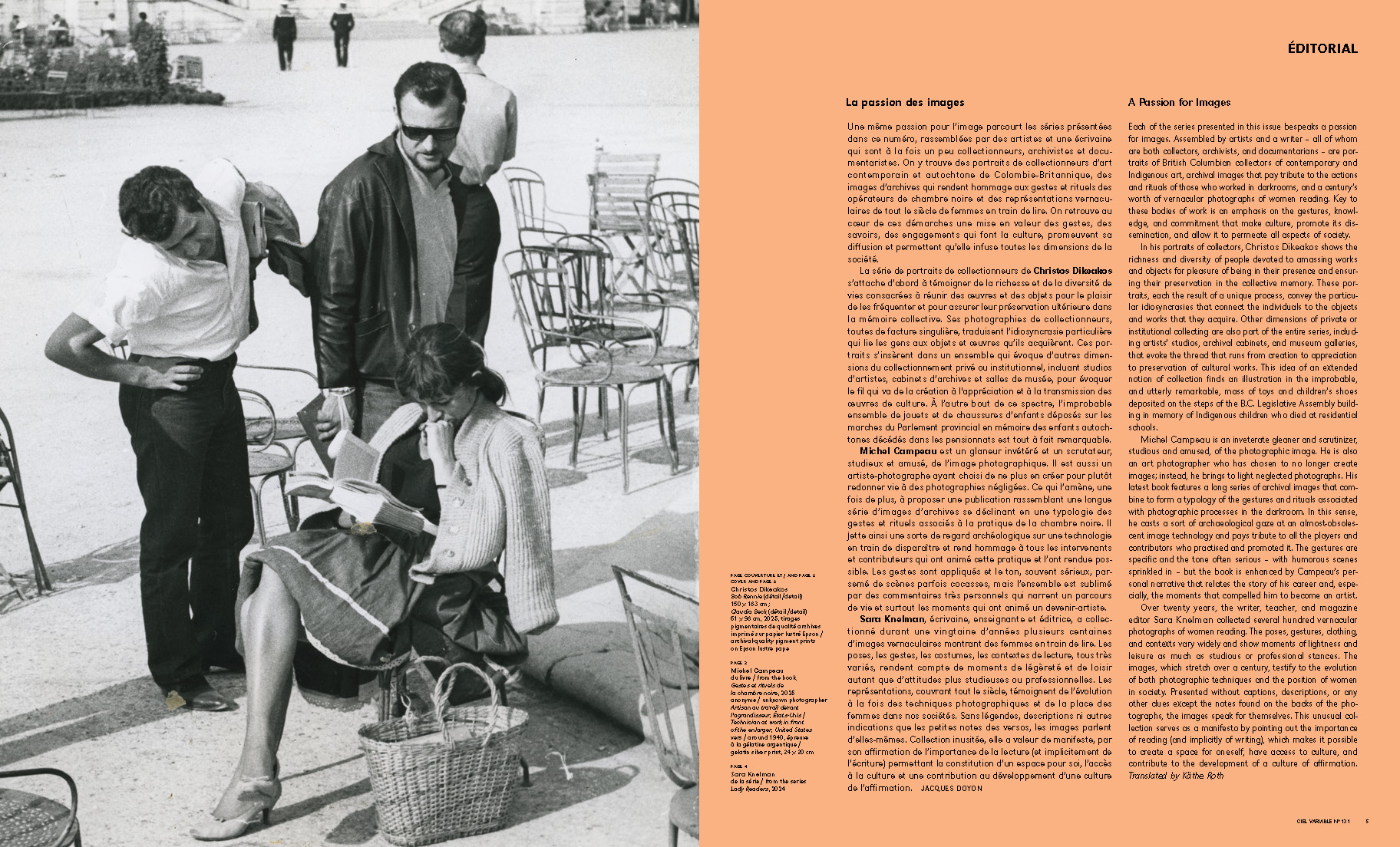
Over twenty years, the writer, teacher, and magazine editor Sara Knelman collected several hundred vernacular photographs of women reading. The poses, gestures, clothing, and contexts vary widely and show moments of lightness and leisure as much as studious or professional stances. The images, which stretch over a century, testify to the evolution of both photographic techniques and the position of women in society. Presented without captions, descriptions, or any other clues except the notes found on the backs of the photographs, the images speak for themselves. This unusual collection serves as a manifesto by pointing out the importance of reading (and implicitly of writing), which makes it possible to create a space for oneself, have access to culture, and contribute to the development of a culture of affirmation.
Translated by Käthe Roth
[ Complete issue, in print and digital version, available here: Ciel variable 131 – Collecting ]
[ Complete article in digital version available here: Editorial: A Passion for Images]