
[Summer 2026]
Editorial
by Jacques Doyon
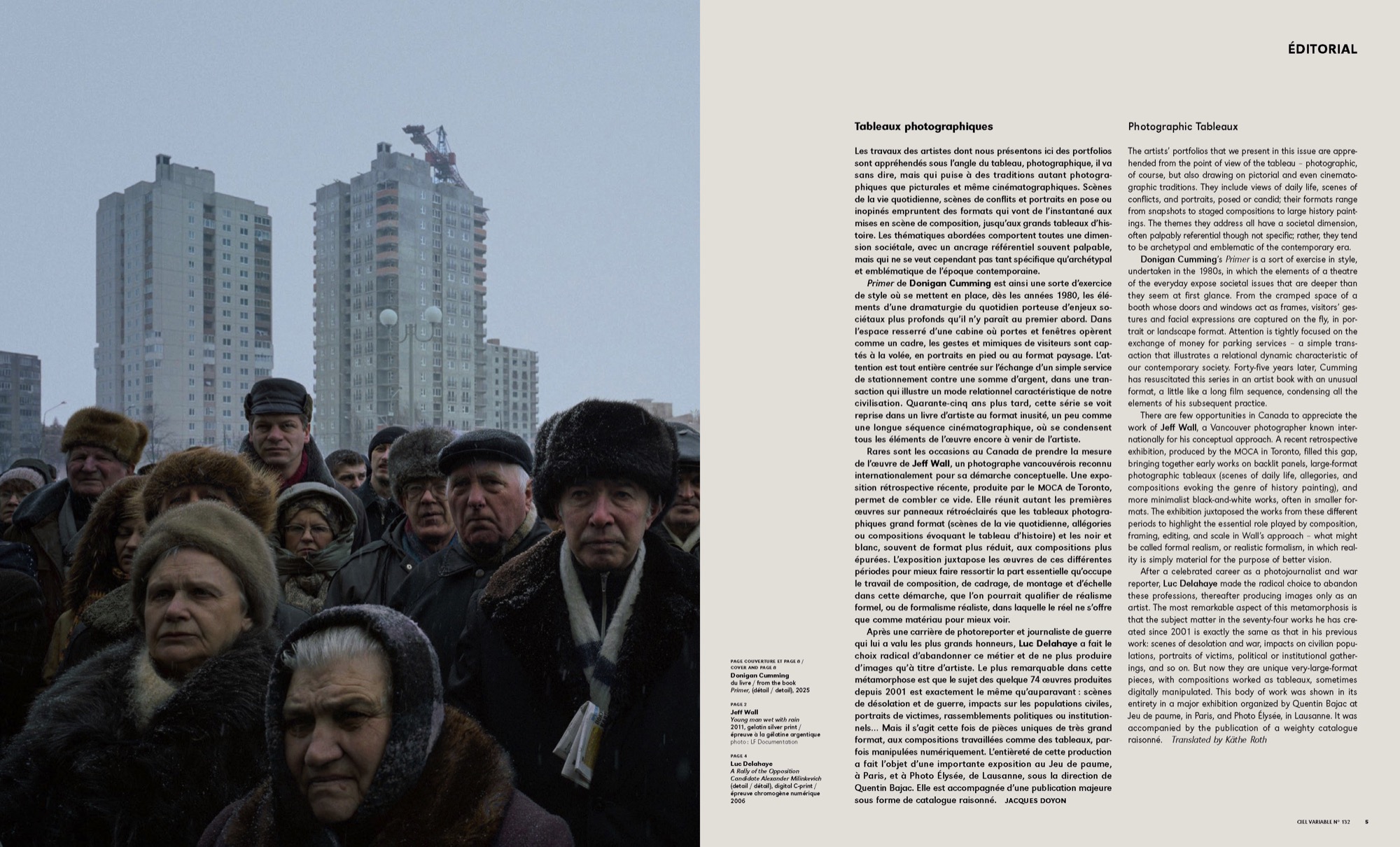
The artists’ portfolios that we present in this issue are apprehended from the point of view of the tableau – photographic, of course, but also drawing on pictorial and even cinematographic traditions. They include views of daily life, scenes of conflicts, and portraits, posed or candid; their formats range from snapshots to staged compositions to large history paintings. The themes they address all have a societal dimension, often palpably referential though not specific; rather, they tend to be archetypal and emblematic of the contemporary era.
Donigan Cumming’s Primer is a sort of exercise in style, undertaken in the 1980s, in which the elements of a theatre of the everyday expose societal issues that are deeper than they seem at first glance. From the cramped space of a booth whose doors and windows act as frames, visitors’ gestures and facial expressions are captured on the fly, in portrait or landscape format. Attention is tightly focused on the exchange of money for parking services – a simple transaction that illustrates a relational dynamic characteristic of our contemporary society. Forty-five years later, Cumming has resuscitated this series in an artist book with an unusual format, a little like a long film sequence, condensing all the elements of his subsequent practice.
There are few opportunities in Canada to appreciate the work of Jeff Wall, a Vancouver photographer known internationally for his conceptual approach. A recent retrospective exhibition, produced by the MOCA in Toronto, filled this gap, bringing together early works on backlit panels, large-format photographic tableaux (scenes of daily life, allegories, and compositions evoking the genre of history painting), and more minimalist black-and-white works, often in smaller formats. The exhibition juxtaposed the works from these different periods to highlight the essential role played by composition, framing, editing, and scale in Wall’s approach – what might be called formal realism, or realistic formalism, in which reality is simply material for the purpose of better vision.
After a celebrated career as a photojournalist and war reporter, Luc Delahaye made the radical choice to abandon these professions, thereafter producing images only as an artist. The most remarkable aspect of this metamorphosis is that the subject matter in the seventy-four works he has created since 2001 is exactly the same as that in his previous work: scenes of desolation and war, impacts on civilian populations, portraits of victims, political or institutional gatherings, and so on. But now they are unique very-large-format pieces, with compositions worked as tableaux, sometimes digitally manipulated. This body of work was shown in its entirety in a major exhibition organized by Quentin Bajac at Jeu de paume, in Paris, and Photo Élysée, in Lausanne. It was accompanied by the publication of a weighty catalogue
raisonné. Translated by Käthe Roth
[ Complete issue, in print and digital version, available here: Ciel variable 132 – TABLEAUX ]
[ Complete article in digital version available here: Editorial + Introduction]