

[Fall 2021]
Women Street Photographers
By Ariane Noël de Tilly
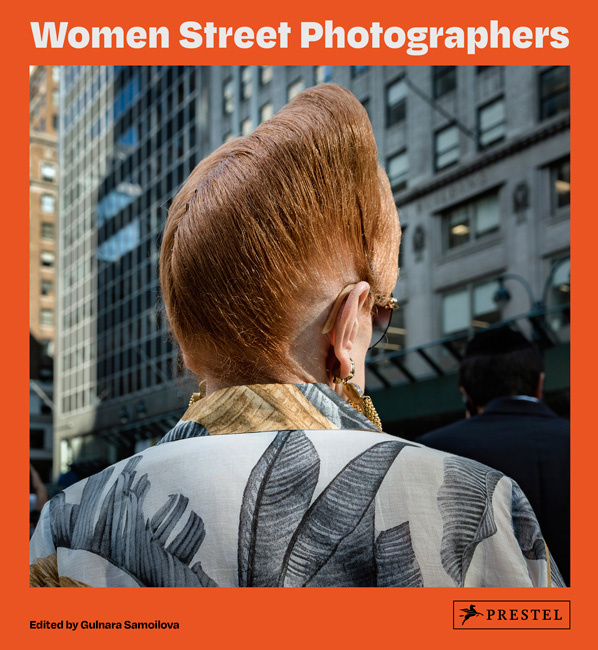
The image chosen to illustrate the cover of Women Street Photographers is certainly striking: a detail from Red Upsweep (2019) by B Jane Levine; the photograph is reproduced in its entirety inside the book. The centre of this truncated image is dominated by the head and shoulders of a red-headed woman with an upswept hairdo, photographed from the back, on Fifth Avenue in New York; in the background are the skyscrapers emblematic of the dense, hectic city. The choice of this detail is judicious, as it guides our gaze: the woman turns her back on us, we watch her watching, and that is exactly what Women Street Photographers invites us to do – to get to know the work of women photographers and the spontaneous, ephemeral events that they have captured in the public space.
Women Street Photographers, edited by Gulnara Samoilova, was published in March 2021, three years after the launch of the Women Street Photographers project, which takes three forms: an annual exhibition, a website, and an Instagram account (@womenstreetphotographers). Samoilova, a photographer born in Russia who has lived in New York since 1992 and who practises both art photography and street photography – although one does not exclude the other – founded the project. Her objective was to raise the visibility of women and people who identify as women, both professional and amateur, whose practice is associated with street photography. This large-scale project underscores the fact that more and more women are entering the field, which has long been dominated by men. The World Atlas of Street Photography, by Jackie Higgins (Yale University Press, 2014), which includes work by a number of women photographers, had previously illustrated this evolution. Women Street Photographers provides even more convincing evidence.
From 2018 to 2020, the annual Women Street Photographers exhibition opened in New York and then toured to other cities. In the context of the pandemic, the 2021 exhibition was held online from May to July. The book Women Street Photographers, published by Prestel, features photographs selected for the first two annual shows. The book is divided into three sections: a foreword by Ami Vitale, an essay by Melissa Breyer, and a hundred photographs taken by a hundred women from all over the globe.
Vitale both reflects on her practice and encourages readers to think about the role of photography in general and street photography in particular. She revisits the early part of her professional career, which started when she was twenty-six. After she had worked for years in conflict zones, including Kosovo, Angola, Gaza, and Afghanistan, an incident related to her equipment saved her life and, as a consequence, influenced the later direction of her work. Over time, she chose to turn her lens to other subjects, setting out to document moments of everyday life that happen in the public space. Her fascinating foreword prepares the ground for what follows in the book – the hundred street photographs that testify to the diversity of the practice. Each image is accompanied by a short paragraph written by the respective photographer, offering a bit more information on the context in which the picture was taken.
Breyer’s essay, “Into the World,” is finely woven; although it is short – under ten pages long – it offers a concise overview of two histories that have intersected since the nineteenth century: that of photography, from daguerreotypes to digital photography, and that of the status of women. Breyer begins with the case in point of novelist Amantine Aurore Lucile Dupin de Francueil, better known by her nom de plume George Sand, who donned men’s clothing so she could walk alone in the streets of Paris. This evocative example, reminding the reader that until relatively recently women could not venture into the street unaccompanied, also explains why street photography was long a difficult undertaking for women.
Breyer also posits that it is difficult to define street photography because, among other things, the practice was not clearly defined to begin with. She cites the Encyclopaedia Britannica, which defines street photography as “record[ing] everyday life in a public place.” After introducing this general definition, Breyer says that she sees a model for the practice in Alice Austen’s body of photographic work. Austen (1866–1952), who lived on Staten Island, loaded her bicycle with her photographic equipment, weighing twenty kilograms, and went in search of subjects: from street cleaners to post office employees, from shoe shiners to fish mongers. Evoking Austen’s practice, Breyer emphasizes that street photography usually involves images caught on the fly, taken spontaneously, avoiding any manipulation.
The rest of the book is devoted to the hundred photographs selected and organized by Samoilova. Rather than grouping the images thematically or geographically, Samoilova chose to let them speak for themselves, refusing to impose a sociopolitical, historical, or contextual interpretation on the reader. The order was established according to an element common to the images that succeed each other. Sometimes, it is a similar composition, as in the case of Victoria Orlova’s A Connection (2018) and Marina Volskaya-Nikitina’s Breakup (2018), both of which present teenagers from the back. Colour leads the transition between Volskaya-Nikitina’s photograph and Andrea Torrei’s Untitled (2019): Breakup presents a night scene dominated by green light, in which two teenagers walk in opposite directions on a street in Nijni Novgorod, Russia, and Untitled, taken in Harar, Ethiopia, shows four teenagers, three of whom are dressed in green, walking home from school and playing in a street one of whose walls is painted green. This strategic choice for connecting the images both highlights the great variety of approaches to street photography and offers a path that reflects the complexity of the world in which we live: we go from mysterious images to funny images, then to romantic images, and on to poetic
images.
Women Street Photographers not only allows for magnificent discoveries but also uncovers happy coincidences linked to our experience of the public space, as exemplified by Ania Klosek’s wonderful photograph contrasting the spontaneity of a ballet dancer performing a leap with the indifferent expression of an elderly woman returning from the market. Although at first glance the book might disappoint readers wishing to find an in-depth essay on street photography offering interpretations of the selected images, an attentive reading offers insight into how intelligently the selection was made, making this a book that is worth consulting again and again. Translated by Käthe Roth
Ariane Noël de Tilly is a professor in the Department of Art History at the Savannah College of Art and Design. She holds a PhD in art history from the University of Amsterdam and has completed postdoctoral studies at the University of British Columbia. In her research, she examines the exhibition and preservation of contemporary art, the history of exhibitions, and engaged art.
[ Complete issue, in print and digital version, available here: Ciel variable 118 – Exhibiting Photography ]