
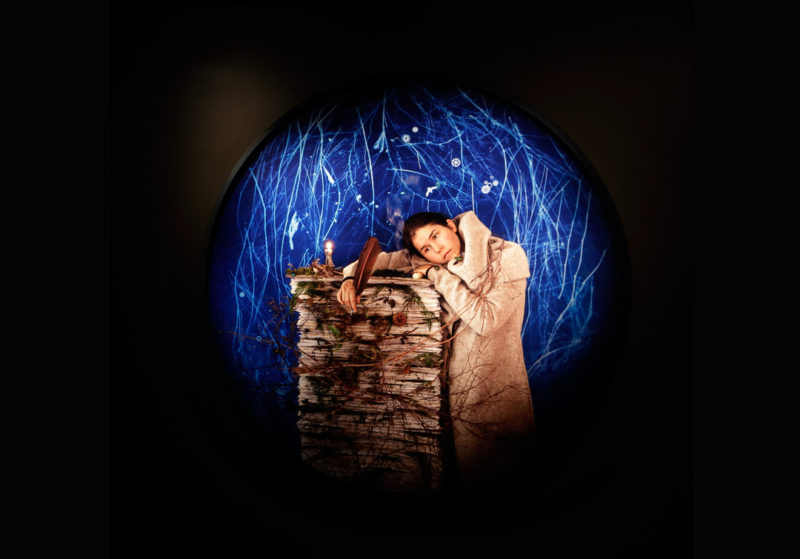
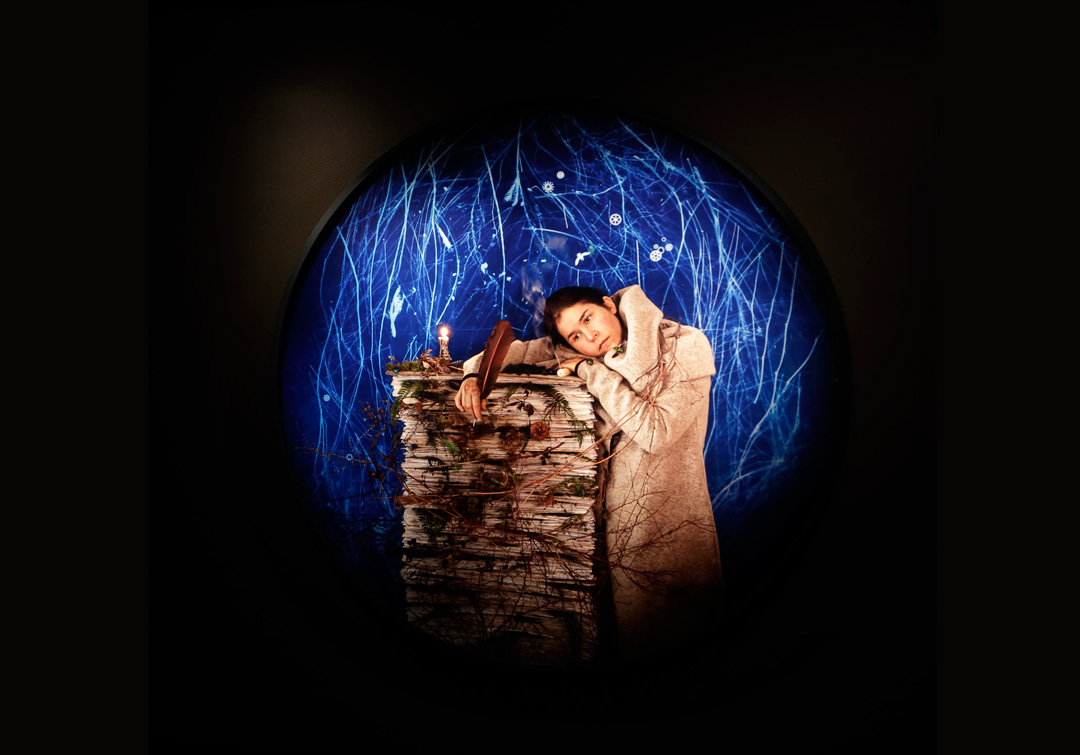
Meryl McMaster, Lorsque la tempête cessera je terminerai mon travail / When The Storm Ends I Will Finish My Work, 2021, tirage sur papier à développement chromogène / print on chromogenic paper, 148 cm de diamètre / in diameter, photo : Marilyn Aitken
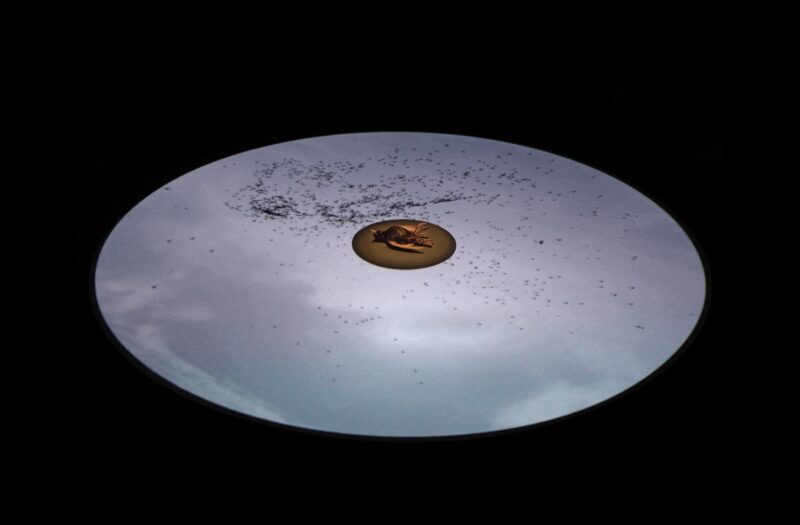
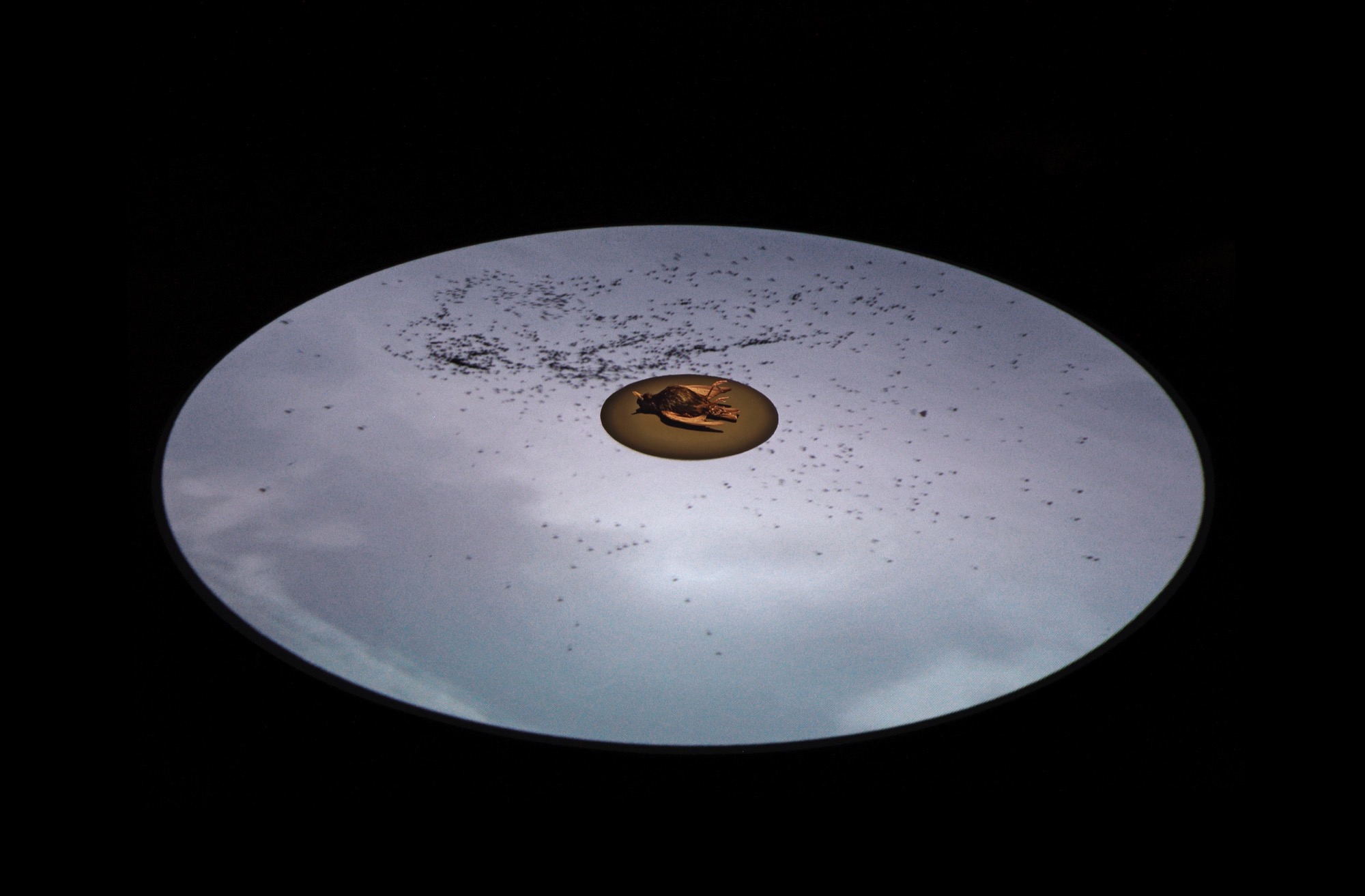
Pour le chant qui suivra / For The Song That Is To Follow, 2021, projection vidéographique sur écran en bois peint, étourneau sansonnet naturalisé / videographic projection on wood screen, naturalized starling, photos : Marilyn Aitken
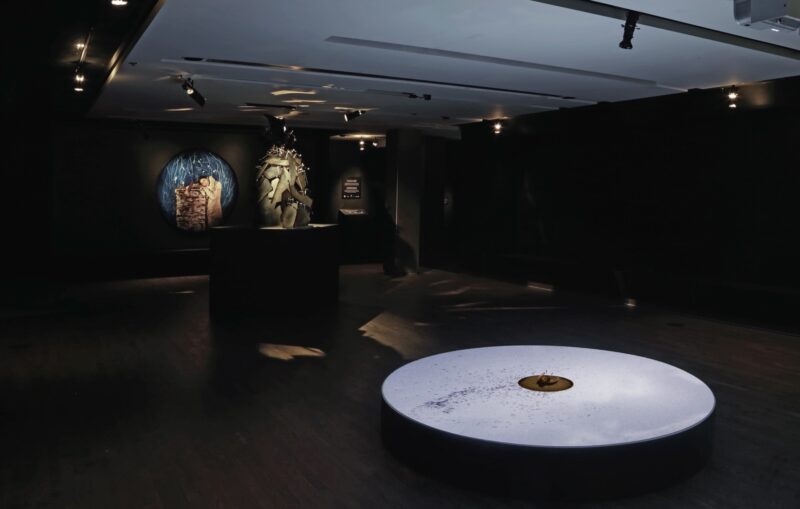
Pour le chant qui suivra / For The Song That Is To Follow, 2021, projection vidéographique sur écran en bois peint, étourneau sansonnet naturalisé / videographic projection on wood screen, naturalized starling, photos : Marilyn Aitken
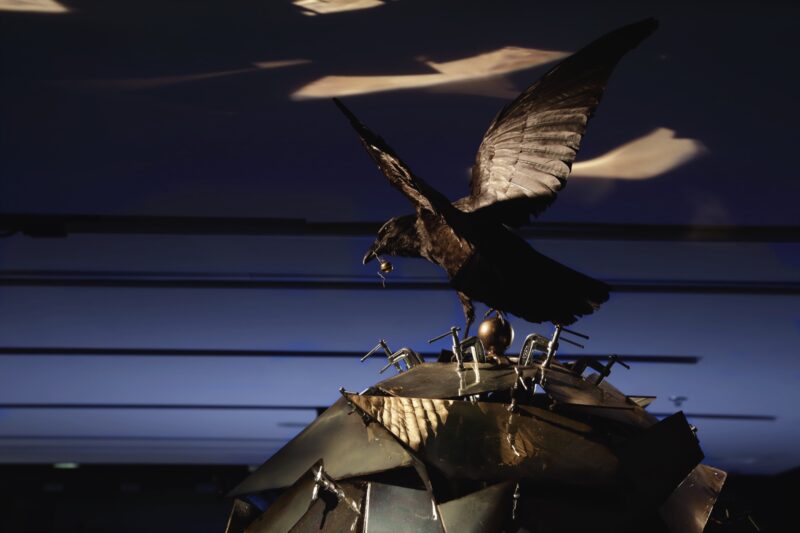
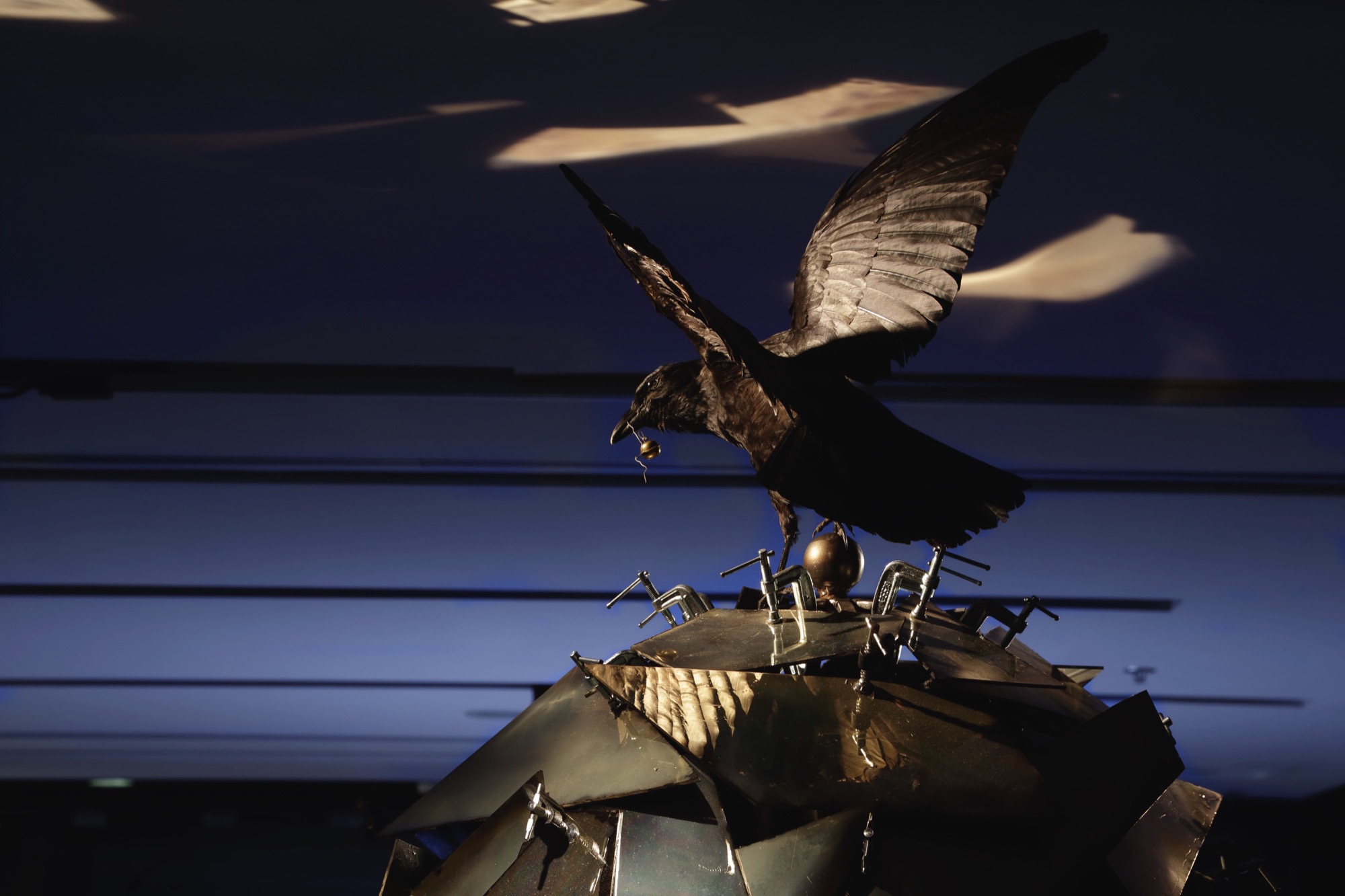
La plume qui sera façonnée par demain (détail) / The Feather That Tomorrow Will Form (detail), 2021, corbeau naturalisé, grelot, métal poli, serre-joints / naturalized crow, sleigh bell, polished metal, clamps, photo : Marilyn Aitken
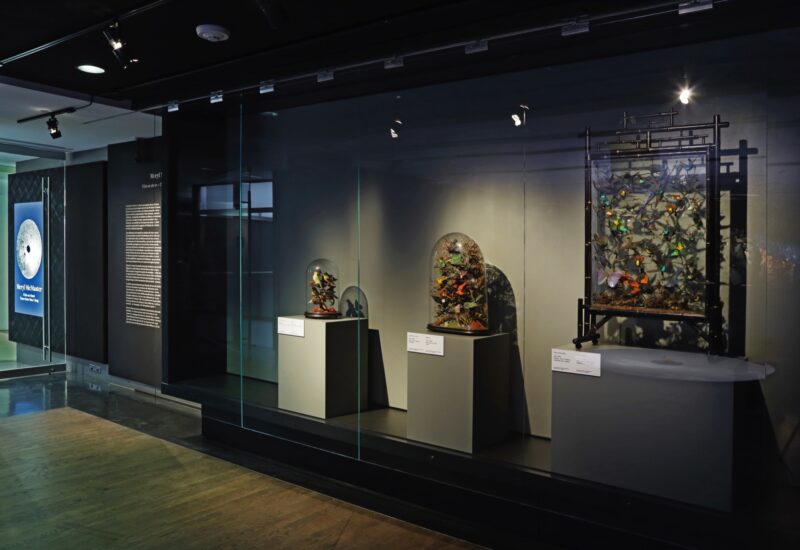
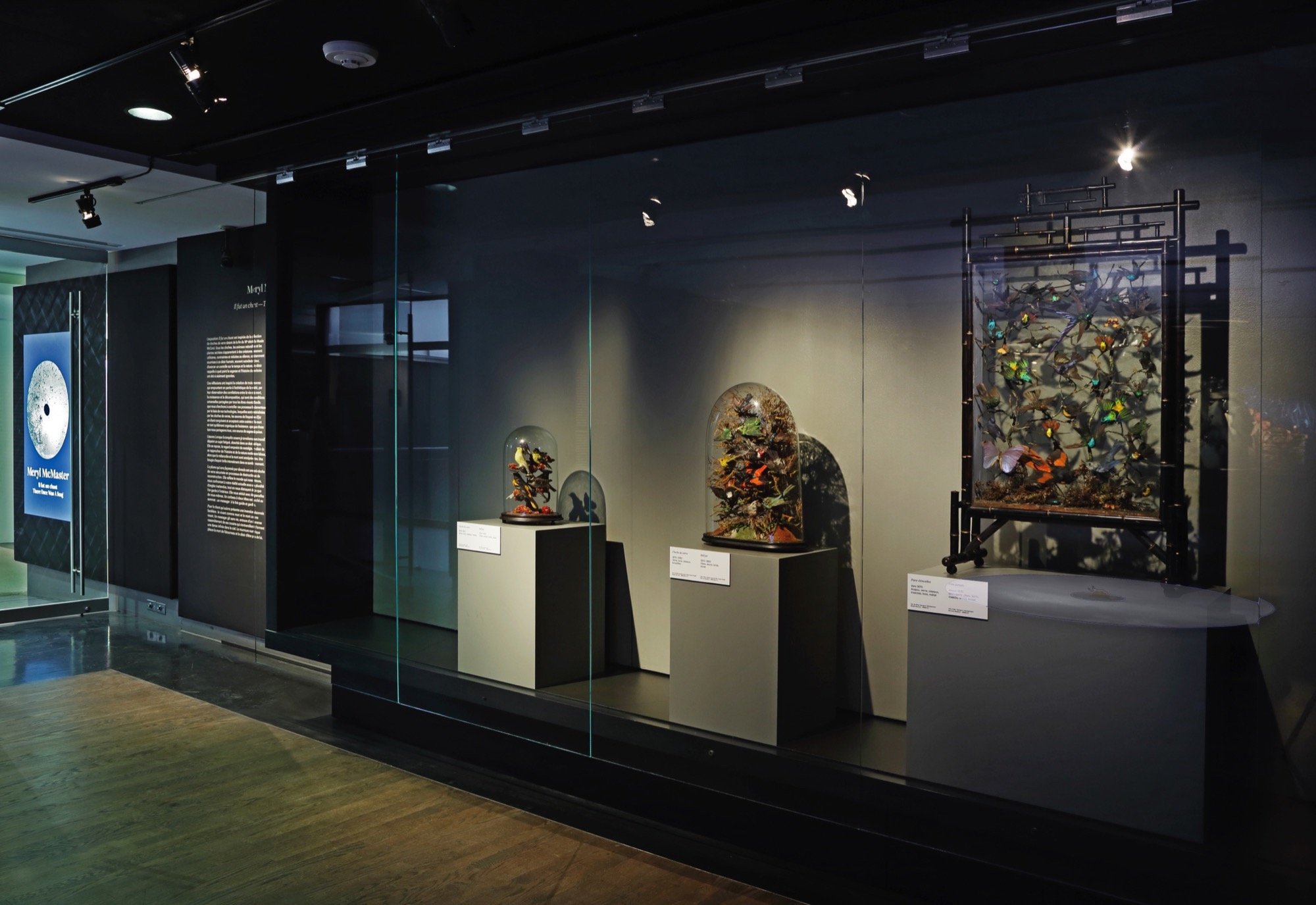
DE GAUCHE À DROITE / FROM LEFT TO RIGHT: cloche de verre / bell jar, 1870-1875, cloche de verre / bell jar, 1870-1890, écran à feu / firescreen, vers 1870, Musée McCord / McCord Museum, photo : Marilyn Aitken

[Fall 2021]
Meryl McMaster, There Once Was A Song
By Stéphanie Hornstein
Occurrence, espace d’art et d’essai
McCord Museum, Montreal
April 2 — August 15, 2021
Starlings have pride of place in Meryl McMaster’s heart. In 2013, she produced a photographic triptych, Murmur, that shows a young woman, the artist herself, gently twirling within a swarm of paper starlings. Grounded in McMaster’s resolve to build bridges between her nêhiyaw (Plains Cree) and European heritages, the piece evokes the challenge of locating individual experience within collective identity.
Anyone who has seen a murmuration of starling understands the beauty and cacophony of this wondrous phenomenon. Now, with her exhibition There Once Was A Song, McMaster returns to the murmuration to think through humanity’s paradoxical relationship with the natural world.
Upon entering the show, the visitor is met with forest sounds: a river flows, leaves rustle, and, periodically, a crow’s piercing cry resonates in the gallery. Created during a residency at the McCord Museum, the works in this exhibition engage with objects from the institution’s collection: three nineteenth-century display cases full of taxidermied birds. One of these astonishing items, mounted in a faux-bamboo frame that bespeaks the Orientalist tastes of the period, contains no fewer than thirty specimens. This particular case is a fire screen, designed to deflect the heat of a parlour fireplace, but the two other objects are bell jars, and this rounded form provides a key for the rest of the exhibition.
Birds, Huron-Wendat curator Jonathan Lainey remarks in a video that accompanies the exhibition, were not the only ones glassed in by Victorian sensibilities. He sees disturbing connections between the obsessive cataloguing of nature and the relegation of Indigenous material culture and peoples to a timeless past. Though this parallel remains implicit in McMaster’s artist statement, she launches her critique from a decidedly non-settler perspective and deplores “how easily the wisdom of the land and its history has been disregarded.” Borrowing from the symbolism of Dutch vanitas, the artworks that form her response grapple with grief while also embracing the transience of all lifeforms.
At the far end of the darkened gallery, a large circular image glows. Those familiar with McMaster’s work will recognize the artist posing as a dejected scholar slumped against a fantastically tall field book. Ferns and pinecones spill out of its pages, suggesting the botanical subjects that the book surveys but cannot contain. Behind the weary figure, twigs float as if suspended in deep-blue amber. This background is a cyanotype – one of the earliest forms of photography – which was commonly used to render the outlines of plants so that they could be better studied. Titled When The Storm Ends I Will Finish My Work, McMaster’s self-portrait is a comment on Enlightenment ideology, which, in its aspiration to tame nature, hastened ecological devastation. She leaves up for interpretation whether the character she embodies is a scientific mind driving industrial progress or a mythical creator awaiting the end of the world in order to piece it back together.
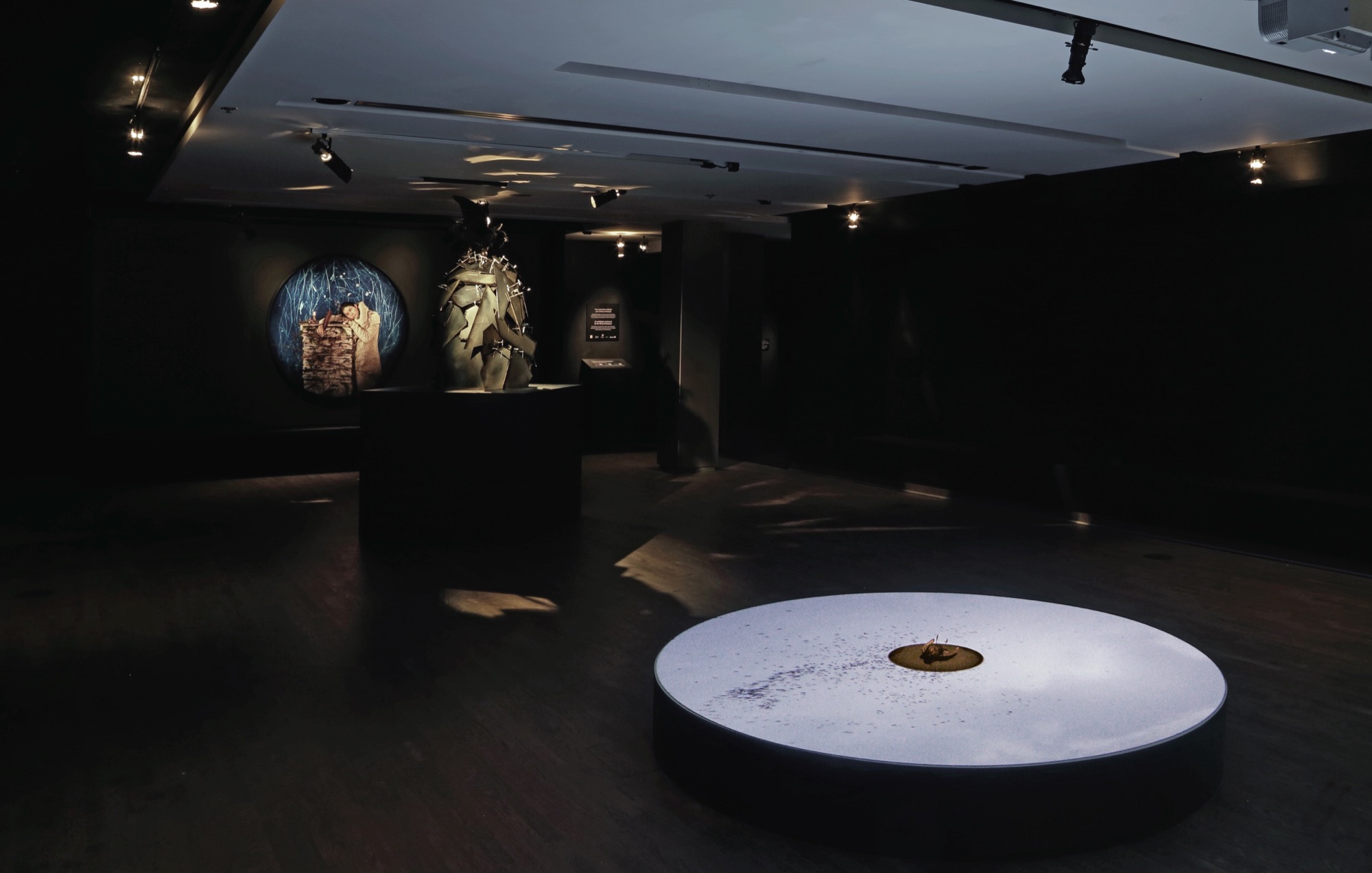
There Once Was A Song marks the first time that McMaster shows sculpture as such, although her photographic practice has long involved crafting elaborately structural costumes. Her evident intuition for material is demonstrated in another piece of the exhibition, The Feather That Tomorrow Will Form. Atop a domed pile of smoky mirrors perches a two-headed crow that, despite its incredible mutation, is the most convincing piece of taxidermy in the room. The raucous bird calls that the visitor has been hearing seem to come from within the structure. McMaster refers to this artwork as the “anti-bell jar” because it is reflective instead of transparent, jagged and jumbled instead of smooth. Try as we might to discern an opening, we do not have access to whatever is inside. The crow, which is both trickster and guide in nêhiyaw cosmology, thwarts our empirical investigations and urges us to change our attitude. Compelling as this sculpture is, its impact is somewhat diminished by being displayed on a tall pedestal that pushes the two-headed bird up against the low ceiling, visually constraining its wingspan.
One last piece in this small but rich exhibition is perhaps the most poignant. At the centre of an illuminated disk, a starling lies belly up. Around it, a computer-animated murmuration teems and surges. The flock is slightly more pixelated than it appears on the exhibition’s poster, but the effect is mesmerizing nevertheless. I’m reminded of Abbas Akhavan’s commission for the 2014 Biennale de Montréal in which he showed eight animals arranged in positions that, contrary to taxidermic convention, connoted death. Of course, all the birds in McMaster’s exhibition are dead, but this starling is the only one that admits it – or, rather, that obliges us to see the others as lifeless. And this is when the full implication of the exhibition’s title becomes devastatingly clear. There once was a song. Perhaps there is no longer? To view this installation as pure gloom, however, is to miss the point. Death, McMaster insists, is a natural, if disconcerting, process and instead of denying it – say, by sticking stuffed birds in bell jars – we would do well to learn from life’s cycles. Yes, the starling is dead, but the title of this piece, For The Song That Is To Follow, promises continuity.
Writing in 1977, philosopher John Berger famously noted that “the cultural marginalization of animals is . . . a more complex process than their physical marginalization. The animals of the mind cannot be so easily dispersed.”1 By this he meant that animals played a formative role in the development of human thought and that to draw a line between us and them, as colonial-capitalist frameworks do, is to disown a core part of ourselves. In asserting the futility of ignoring natural law, McMaster conjures plenty of “animals of the mind” whose wordless message of caution and kinship will be impossible to forget.
1 John Berger, Why Look at Animals? (London: Penguin Books, 2009 [1977]), 25.
Stéphanie Hornstein is a PhD candidate and course instructor in the Department of Art History at Concordia University in Montreal. Her doctoral research is concerned with tracing patterns in nineteenth- and early-twentieth-century travel photographs of the broad region that was designated by Westerners as “the Orient.”
[ Complete issue, in print and digital version, available here: Ciel variable 118 – Exhibiting Photography ]