
[Summer 2022]


By Nicolas Mavrikakis
SBC galerie d’art contemporain, Montréal
4.11.2021 — 18.12.2021
Whatever one might do or say, many people continue to see photography as having an aura of truth. Its authoritative status with regard to the potential to capture reality, a historical construction inherited from the nineteenth century, is a persistent cliché. Theoreticians of the image, teachers, and the mainstream media would all do well to warn against the effects of realism in the photographic image, but no one does; the tenacious idea that photographs show reality continues its ravaging effects of bolstering credulity. And yet we know that politicians of all stripes have manipulated, and still manipulate, photographs. We also know how the advertising world distorts images. And we are all aware that such tampering is even easier with computers. Will photographs finally be the thing that reveals people’s credulity – spectators as easy to fool as those who viewed Zeuxis’s birds in ancient Greece?
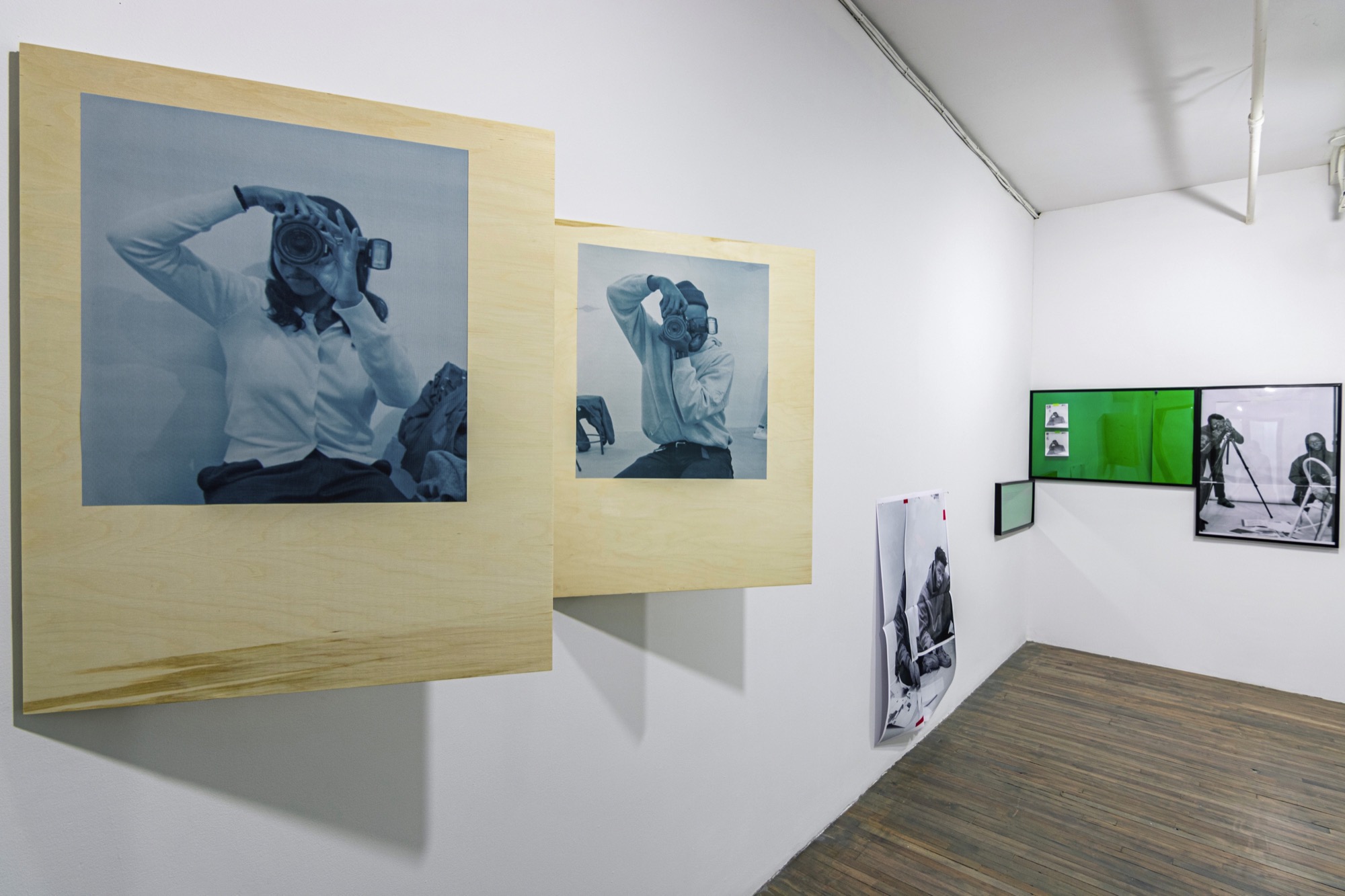
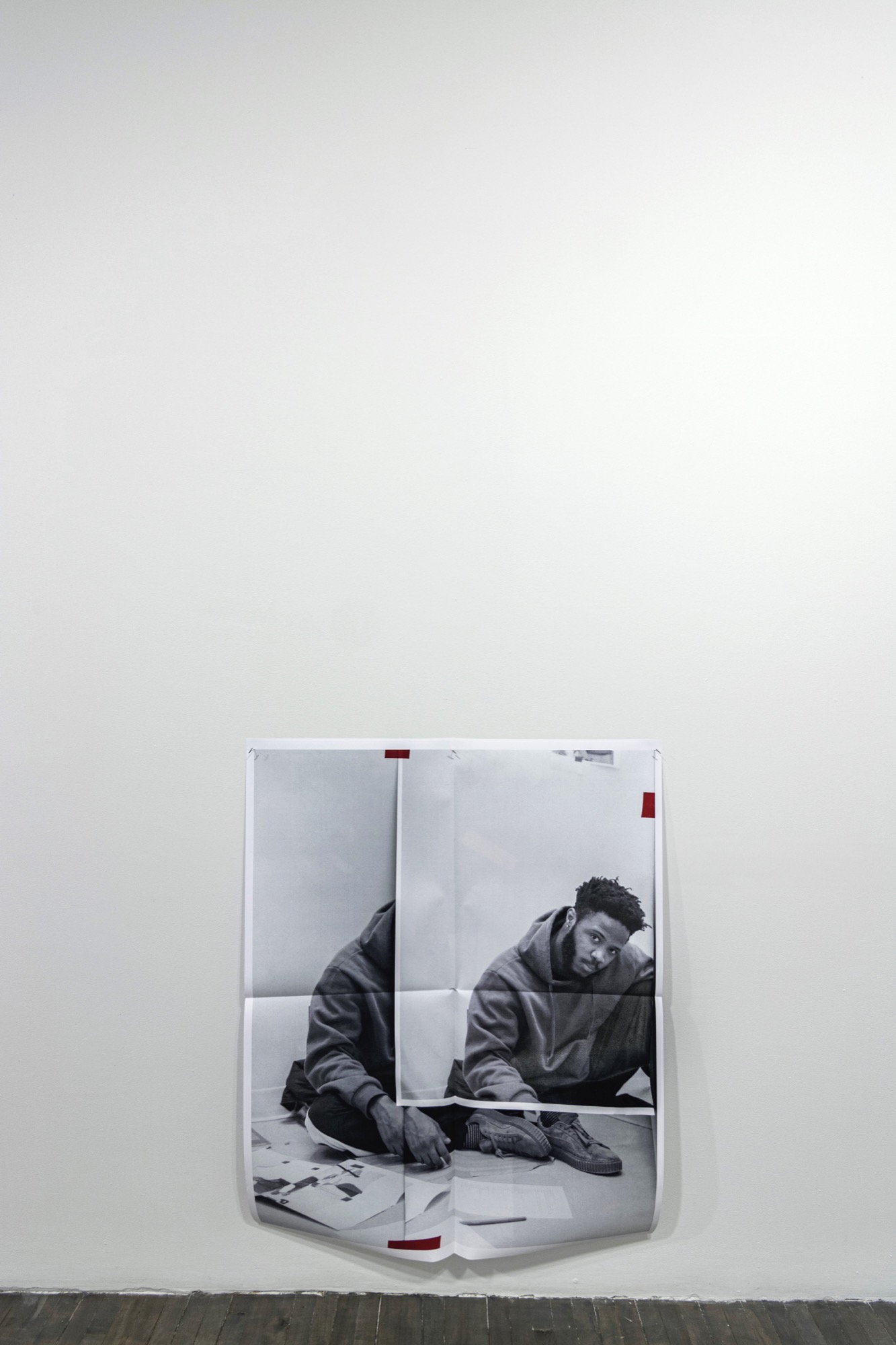
In this context – which is worth a broader discussion – Luther Konadu’s exhibition Portraiture en gestuelles, organized by curator Nasrin Himada, delicately raised the persistence and, especially, the surprising fragility of the photographic lie. On the walls of the SBC exhibition centre, his series of photographs, arranged as an installation that took possession of the entire space, often showed the same people. These sequences of images encouraged visitors to look for the difference – one might even say the error. Each picture was just a bit different, due to minimally displaced shooting angles and moments that were a touch divergent, barely gapped in time. For Konadu, one picture is not enough.
These slightly discordant points of view and slightly delayed timeframes were amplified by how the images were hung. Some of the series stretched right to the corner and continued on the next wall, inviting visitors to move in order to see them better, as they couldn’t all be seen at once. Some were also placed on both sides of triangular panels attached to the wall.
Let’s remember something obvious: photography presents the world from a certain point of view. This results as much from using the camera to excise the real as from the ideological context ruling society. In each image or series of images, the spectator must reconstruct the truth from the fragments that the photograph shows.
Konadu’s images, which featured individuals talking to each other, were also decontextualized. In what situation were these people talking? The exhibition is not clear on this subject. The presentation text mentions “a community, a collective.” Are they friends? Members of Konadu’s family? A social or political group? Konadu seems to want us to use our imagination. But then, isn’t it the fate of all images to be decontextualized, and then recontextualized and reinvented by the viewer? In this exhibition, could we see an echo of the Kuleshov effect (1921) – the famous visual experiment that showed how, through the editing of a film, an image changes meaning depending on its proximity to other images? Konadu seems to say, rather, that the photographic image is silent, mute. In the timespan of a single generation, we forget the identities of the individuals shown in family pictures or in photographs of celebrities. Without narration to contextualize it, an image is always a bit voiceless. Could photographs be screens onto which we can project something imaginary that appears to be reality?
The imaginary associated with the photograph can also spell out how the truth of the world has often been rooted, at least since the Renaissance, in the staging of appearances. And yet, we know that reality, too – and especially – depends on what we are able to apprehend through our own eyes or on everything that is out of field or out of frame.
Konadu suggests that photographic realism is a historical invention linked to a certain idea of progress, an invention based on belief in the superior power of technologies and sciences. The fact that science – and photography, its offshoot – served in the nineteenth and twentieth centuries to spread racist theories cannot be ignored when we look at the images portraying Black individuals. In this exhibition, the photographed excerpts of an essay by bell hooks, the feminist author who criticized the representations of the Black community, reinforce this reading. Translated by Käthe Roth
1 It is worth noting that this hanging method is also used often by the photographer Yan Giguère in, among others, L’éclaircie and La forêt du chevreuil à lunettes, of which excerpted works were presented at the 10th Rencontre de photographie du Kamouraska, in 2021.
2 See Molly Rogers, Delia’s Tears: Race, Science, and Photography in Nineteenth-Century America (New Haven: Yale University Press, 2010); Brian Wallis, “Black Bodies, White Science: Louis Agassiz’s Slave Daguerreotypes,” American Art 9, no. 2 (1995): 38–61.
Nicolas Mavrikakis is a critic for the newspaper Le Devoir, having filled the same position at Voir for fifteen years. He has written for numerous magazines, for some of which he has been a member of the editorial committee (Spirale, ETC, Espace). He teaches at Collège Brébeuf, is an exhibition curator (retrospective Pierre Ayot in 2016–17), and has published La peur de l’image (2015) and L’illusion postmoderne? (2021). In his free time, he is an artist.
[ Complete issue, in print and digital version, available here: Ciel variable 120 – FIGURES OF AFFIRMATION ]