
[Summer 2022]

Michel Boulanger, Dans ces rangs de lignes pressées, 2022, arrêt sur image, vidéo d’animation numérique HD, noir et blanc, son / still image, HD digital animation, black and white, sound, 9 min
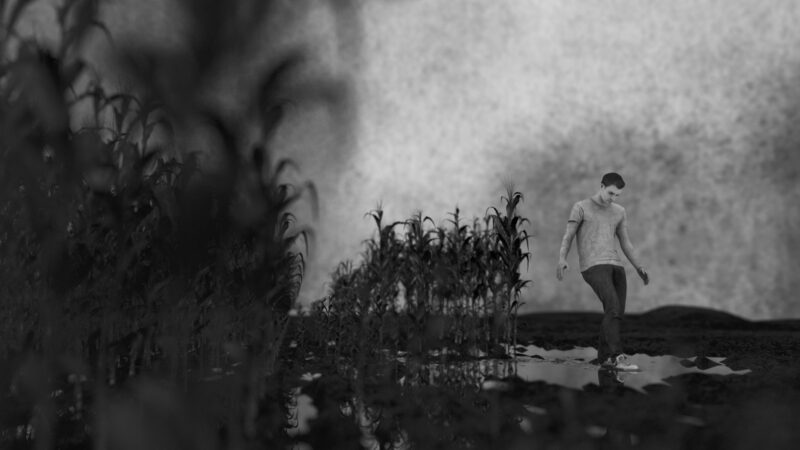
Michel Boulanger, Dans ces rangs de lignes pressées, 2022, arrêt sur image, vidéo d’animation numérique HD, noir et blanc, son / still image, HD digital animation, black and white, sound, 9 min
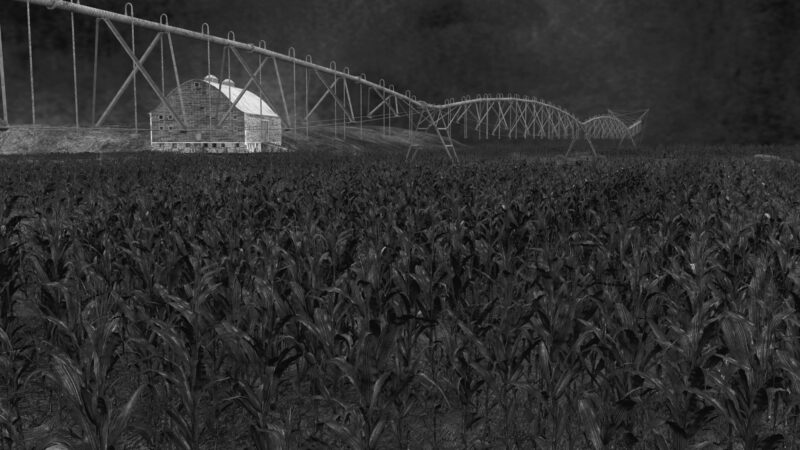
Michel Boulanger, Dans ces rangs de lignes pressées, 2022, arrêt sur image, vidéo d’animation numérique HD, noir et blanc, son / still image, HD digital animation, black and white, sound, 9 min


By Daniel Roy
Occurrence, espace d’art et d’essai contemporains, Montréal14.01.2022 — 19.02.2022
Through his art practice, Michel Boulanger has developed a specific interest in industrial technologies and how they transform the agrarian landscape. His most recent animation video, Dans ces rangs de lignes pressées, presented at Occurrence, portrays the anxieties and turmoil of farm-machinery operator who questions the methods and aims of his trade. In this superbly drawn fictional world, Boulanger illustrates, through the young worker’s thoughts and actions, the loss of human contact with nature – nature whose exploitation is subjected to the logic of yields and productivity.
In the opening of this dark-toned black-and-white video, a shot of the sky reveals a luminous sphere behind the clouds. Is it day or night? Either perspective is plausible, as industrial agricultural production never stops. A synthetic voice informs the operator that the GPS has been programmed: “We will work within standards and we will play with time.” As the tractor sets forth into the field and deploys its harrows to fertilize the soil, the young man rejects his role, showing his resistance by executing a series of actions: he leaves the cockpit, runs through the rows of corn, sits on the nose of the vehicle, pretends he’s a tightrope walker on the hood. There’s no longer a question for him of toeing the line: “The end of this operation is not a destination.”
A later sequence takes us to an adjacent plot, where there is a barn. Within, a beam of light filters in between the walls’ poorly squared planks, illuminating a bird on the ground. Slowly, the shot pulls back to reveal the vastness of the place, in which the bird now seems minuscule. Suddenly, a cabbage, which seems to have been thrown through an opening in the roof, falls and lands, intact, in the centre of the barn. This cruciferous vegetable is no doubt the first to be gathered. And this huge building will serve as a warehouse to store others like it. The scope of this harvest, the result of mass agriculture, is imagined by Boulanger through the idea of a void that will ineluctably be filled.Breaking with the narrative, the following sequence shows, in an empty, immaculately white space, a 3D model of a farm machine, also entirely white, that rotates on its axis in a seeming state of weightlessness. Its gyrating movement allows us to examine it from every angle, and therefore to fully appreciate the complexity of its design. In this short scene in which the images are perfectly clean, there is an impressive profusion of details, rendered with strict precision. This prototype, presented in this way, gives us a glimpse of the sophistication of today’s farm machinery.
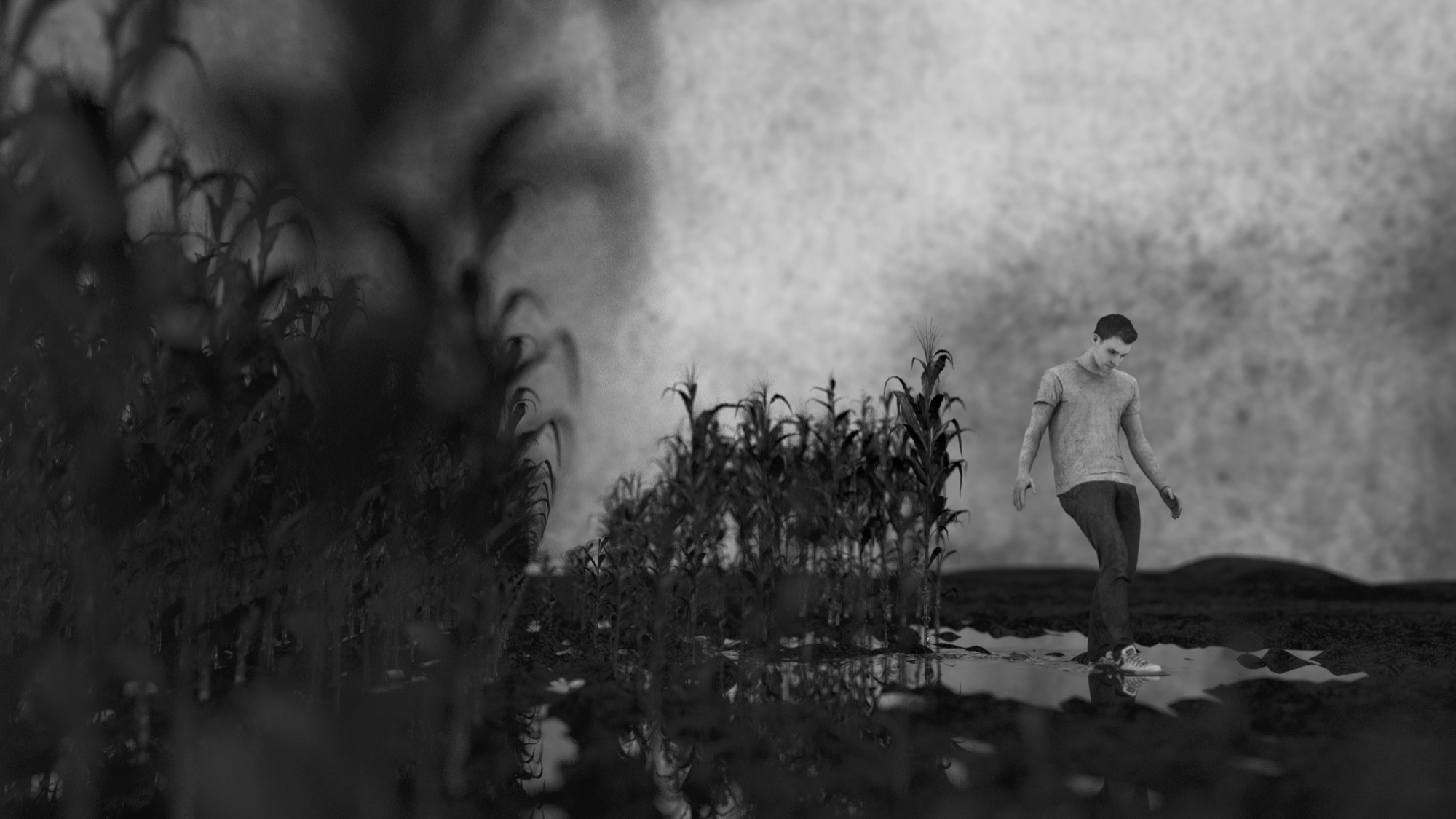
Returning to the corn field, the tractor suddenly veers from its path and stops short. The operator has succeeded in momentarily halting production. During this pause, he splashes around in a mud puddle, ducks his head in it, and lies down in the muck, moving his arms and legs like a kid making a snow angel. These games evoke childhood, the time of life when knowledge of the world is acquired through the senses. In his body’s contact with matter, the young man shows his need to restore a sensory connection with the land.
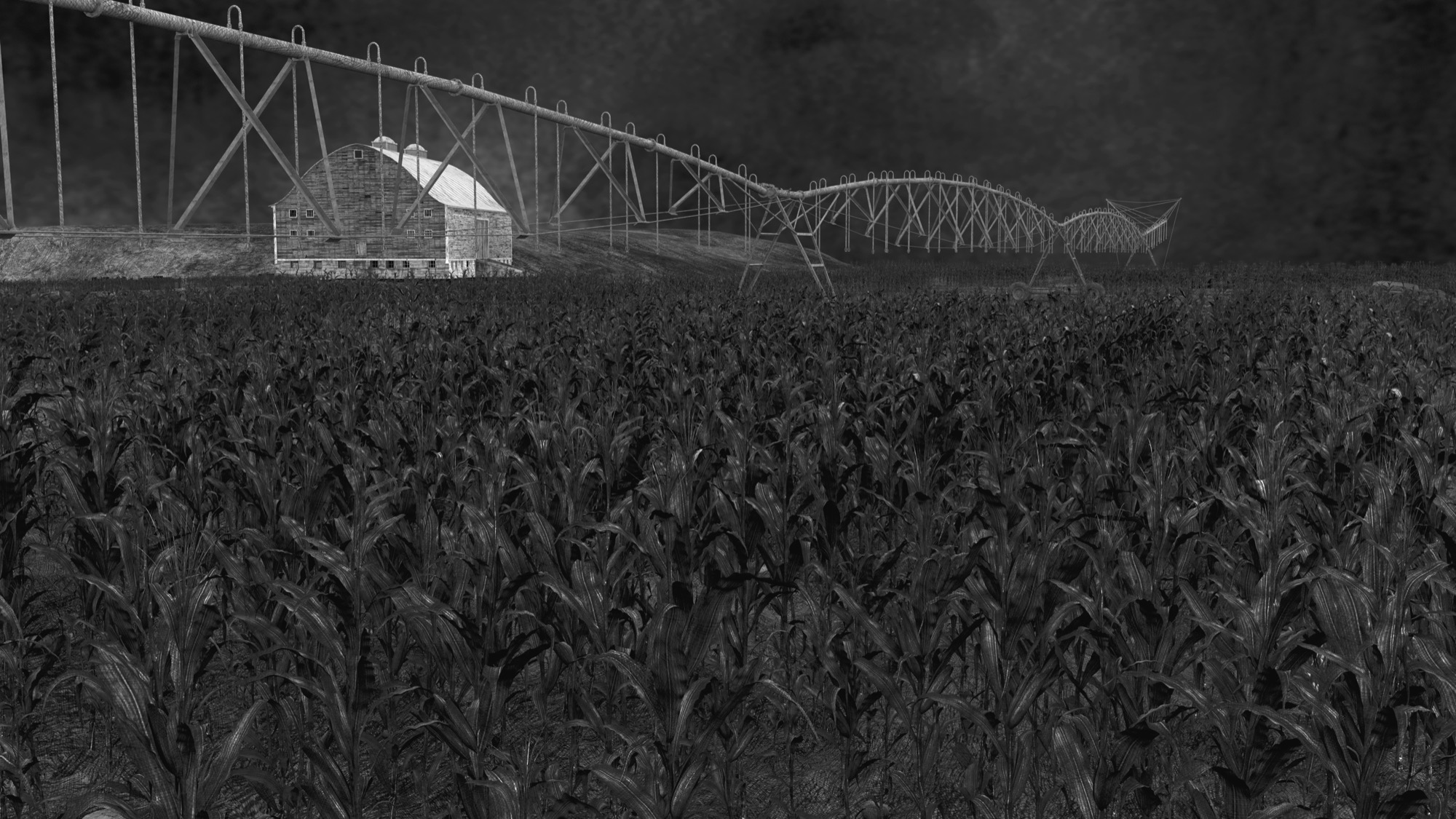
In Dans ces rangs de lignes pressées, Boulanger short-circuits the picturesque imagery of traditional farms that live on in our imaginations; instead, he shows how deeply technology has been integrated into today’s agro-industrial sector, transforming farming. We can see this, for instance, in the use of GPS, which steers the tractors in the fields, and in the complex engineering of the machines and farm equipment. Furthermore, the view of imposing irrigation structures criss-crossing the fields in a symmetrical and regular architecture, contrasting with the organic shapes of the corn plants,
offers views of a grand, but disquieting, beauty. Even more, Boulanger’s video encourages us to reflect on the development of an industry that, by seeking constantly to optimize its yields and profits, is constantly digging the furrow of exploitation deeper, at the risk of losing contact with the nature that it cultivates. How fully are we confined in this productivist system? “Is this huge space, with its fields that all look the same, really outdoors?” wonders the operator. To take the measure of this imprisonment, maybe we, like the young man, have to find a way to step out of line. Translated by Käthe Roth
A graduate of Collège Marsan in professional photography, Daniel Roy is currently pursuing a master’s degree in art history at UQAM. He is interested in the notion of temporality in the image and in artists who appropriate old photographic processes to engage with contemporary discourses.
[ Complete issue, in print and digital version, available here: Ciel variable 120 – FIGURES OF AFFIRMATION ]