

[Fall 2025]
Luminous Imprints
by Pierre Dessureault
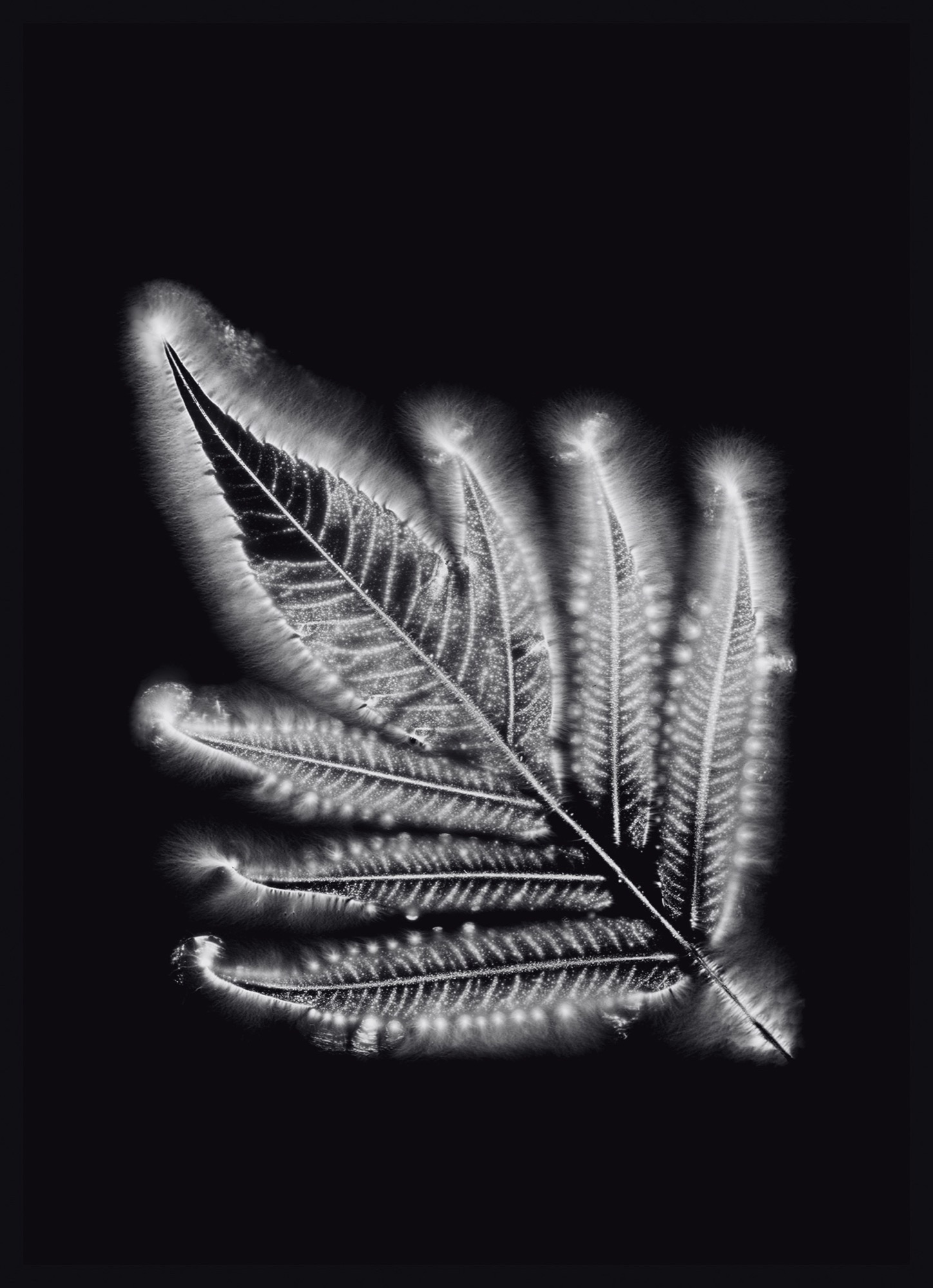
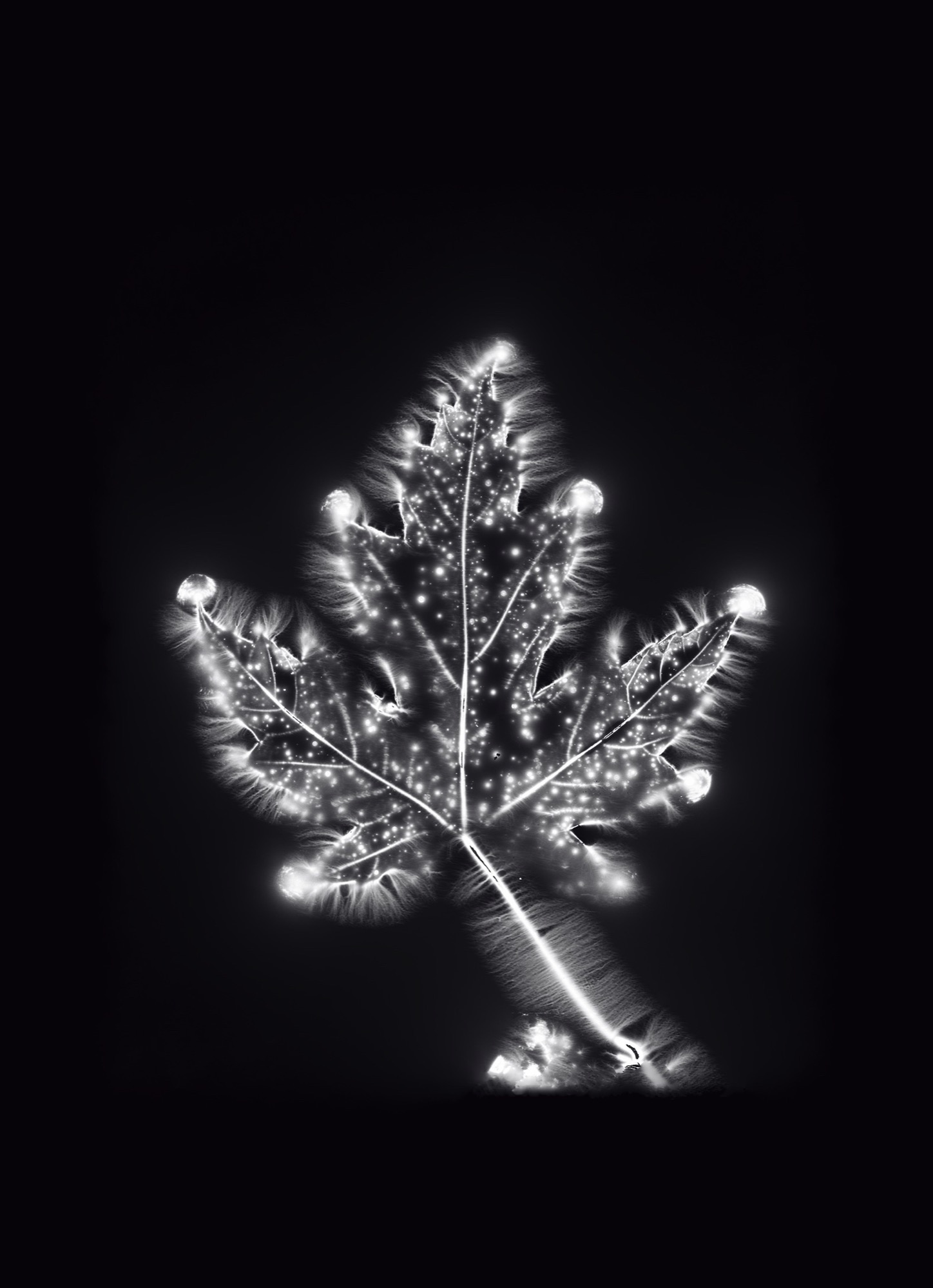
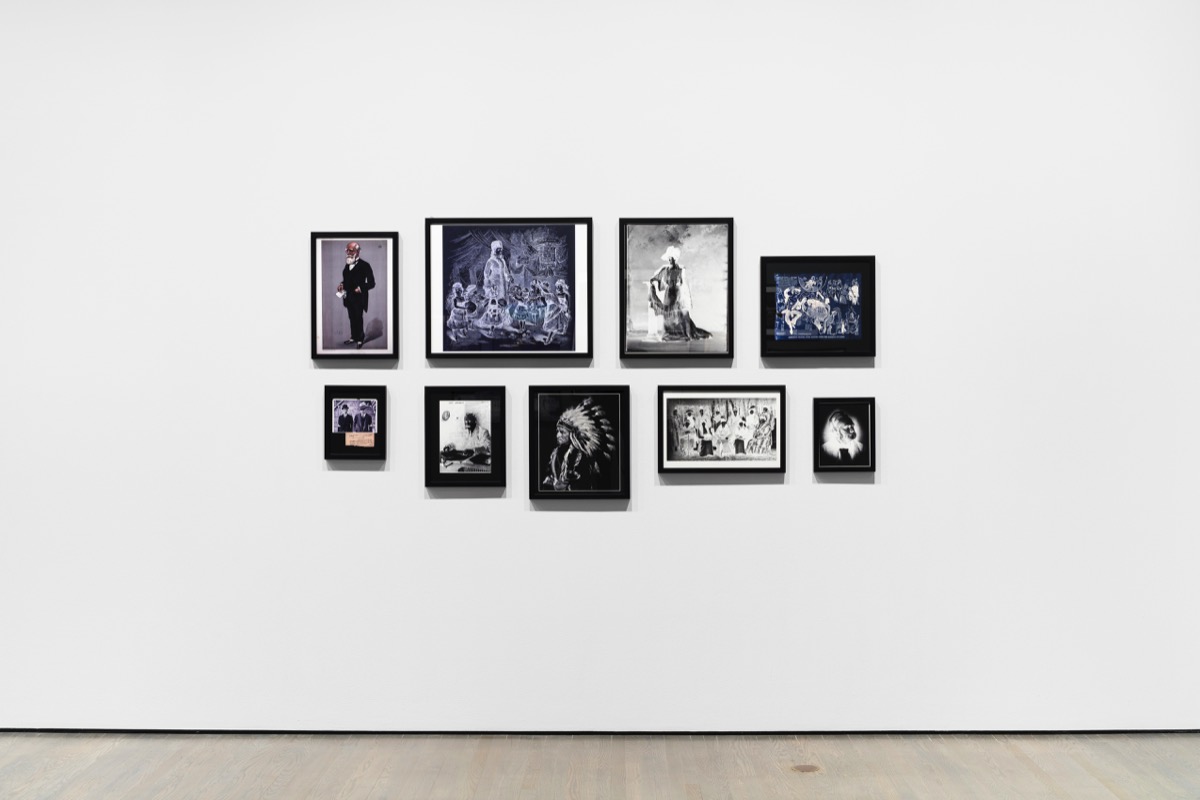
Since 1994, Marie-Jeanne Musiol has been engaged in a unique exploration of the porous borders between how science and art represent nature. Most of the images in the exhibition I See Stars in the Deep Dark were from the series Bodies of Light and were made between 2018 and 2024. The small-format photographs, deployed in constellations on the gallery’s white walls, presented energy imprints of botanical specimens produced by electrophotography, also called Kirlian photography after its inventors, the Soviet researchers Valentina and Semyon Kirlian, in 1939. “In electrophotography, or energy photography,” Musiol writes, “a body (human organ, plant, water, mineral) is penetrated by an electromagnetic discharge that causes a luminous corona to appear. Thanks to a camera-free technique related to the photogram, the image of the corona is immediately recorded on the analogical surface of film or photographic paper.”
By imbuing an image with the profusion of the visible world revealed in the tangled flow of perception and the momentary gaze, science and art unite in a process of deciphering and learning about the natural world. Musiol is following in the footsteps of pioneers of a medium with the marvellous power to fix “fairy pictures, creation of a moment” and through which “natural objects may be made to delineate themselves without the aid of the artist’s pencil.”
Musiol’s prints create a new configuration of the visible world and uncover the contours of a previously unexperienced view of nature. By putting them end to end in a visually poetic logic intended to create echoes and kinships among the images, she lays the cornerstone for a process that leads to the composition of an energy herbarium: “For centuries,” she explains, “naturalists have named and classified specimens in herbaria in order to grasp the organizing plan of the vegetal world. Without seeking to achieve same exhaustive scope, the emblematic herbarium that I create freely assembles small figures of radiating plants. Some species are organized according to logical botanical groupings. More often, they are deposited in the herbarium as representations of an energy state caught live by electromagnetic photography.”
Musiol’s herbarium takes over from pure observation involving the gathering of imprints and becomes the basis for an ordered reality. Although she acknowledges that there is something systematic about her research, including her rigorous approach and the limitations imposed by the picture-taking apparatus, her classifications are not those defined by the science of Buffon, Linnaeus, and Marie-Victorin, who were interested in describing and archiving specimens. Rather, her energy herbarium contains a repertoire of impressions of the living in which perceived reality, in all its bounty and depth, is transposed into images to offer new ways of seeing the specimen depicted – a new universe of visibility. This photographic visibility, which is not defined by physical characteristics that can be seen by the naked eye, is far from producing an identical double of the object’s materiality – a procedure belonging to studies from nature in which the contours and observable properties of the specimen are retraced as accurately as possible. Musiol’s reality is that of traits captured through a process (the use of an electrostatic apparatus) that unveils otherwise invisible energy fields, for “it is another nature which speaks to the camera rather than to the eye: ‘other’ above all in the sense that a space informed by human consciousness gives way to a space informed by the unconscious.” Thus, the botanical specimen is taken from its own space and time, which define it as an object of study, and brought into the time and space of the image – a reality that eludes perception and opens to the invisible within the visible. Seeing becomes knowing.
Musiol situates her energy herbarium project in the lineage of two historical approaches that were milestones in the portrayal of nature through photographic images. First, between 1843 and 1853, Anna Atkins, a British artist and member of the Botanical Society of London, published twelve fascicles containing hundreds of cyanotypes inventorying the algae of the British Isles. She had started as an illustrator for her scientist father, but when she saw the public presentation of William Henry Fox Talbot’s newly invented photogenic drawing technique she recognized an unprecedented way of observing and depicting nature. The German astronomer Johann Heinrich Madler, commenting on Fox Talbot’s invention, observed, “Fresh and dried flowers are reproduced exactly, down to the most faithful detail of the venation. As this takes place by laying the flowers on the paper, it is merely the veins’ greater opacity as compared to the leaf cells that preserves the outlines of the former in a brighter light. Naturally, the outlines are microscopically precise.”
With her imprints of natural forms produced by the photogenic drawing process of direct contact between the botanical specimen and the sensitive surface, Atkins freed the plant’s representation from human intervention, therefore introducing a new objectivity. Unlike drawing from nature, dependent on artist-illustrators’ dexterity and ideas – which led them to omit certain details to reproduce a sort of idealized portrayal of their subject – photogenic drawing, through physical and chemical transcription, delivered the entirety of the object accurately and in detail, eliminating discrimination and hierarchy.
Second, from a completely different angle and decades later, in the early twentieth century, when technical advances had made it possible to create reproductions of much greater precision – compared to the often blurred and approximate contours of Atkins’s photogenic drawings, which fixed a fleeting shadow of nature – the German photographer Karl Blossfeldt turned the camera into an investigative tool to record the things of the world objectively, without interference by style or aesthetics. He was aiming to produce, by a complex staging of botanical specimens, a systematic visual inventory of plant forms and structures to uncover their essential motifs. Using strategies specific to the photographic medium – surgically exact rendering of the image, systematic close-up framings, simplification of subjects presented on a neutral background with direct lighting, enlargement capturing maximum detail – he amplified vision and highlighted textures and contours in representations that showed the geometric structure of plants. The resulting images doubled what was visible with all the fidelity of a mirror reflection that conserved the traces of a reality in which the uniqueness of the living object is reduced, through reproduction, to its most basic form. Thus, he constructed a grammar of styles by showing, through images, the correspondence between stylized renderings of natural structures and creations by the human hand in the decorative-arts field. “Blossfeldt, with his astonishing plant photography,” wrote Walter Benjamin, “revealed the most ancient column forms in pewter-glass, a bishop’s crosier in the ostrich fern, totem poles in tenfold enlargements of chestnut and maple shoots, and gothic tracery in the fuller’s whistle.”
The key element in Atkins’s and Blossfeldt’s approaches was light, which produced the image and engraved it on the photographic material. In her herbarium, Musiol defines the forms of specimens by cutting them out and placing the imprints in the non-space of blackness. Black, here, is a reference not to the symbolism with which it has associated almost forever, but to the materiality of the colour, its physical qualities. Black: absence of light. Black: too much light, which burns the sensitive surface, inscribing upon it an energy imprint of a thing. This materiality, which accentuates and affirms a singular presence of the medium, brings to mind the work on pictorial matter by Pierre Soulages, who, in his immense black paintings, produced gestural marks of his interventions in a black that was bottomless yet radiant – “beyond black.” “Outrenoir means beyond black, a light reflected, transmuted by black,” Soulages wrote. “Beyond black, black ceases to be black, becomes an emitter of clarity, of secret light. Beyond black: a mental field other than that of black.”
Musiol’s short video, presented in parallel with the exhibition, retraced this path from black to the light. The images slowly and inexorably melt into each other in a fluid motion, the luminous halos surrounding the leaves growing and accumulating until they bathe the entire surface of the screen in a bright light into which the natural specimens, now pure energy traces, dissolve. From the black depths surges the dazzle of pure, transparent light. “But after all, what is Nature, but one great field of wonders beyond our comprehension? Those, indeed, which are of every-day occurrence, do not habitually strike us, on account of their familiarity, but they are not the less on that account essential portions of the same wonderful whole.” Translated by Käthe Roth
[ Complete issue, in print and digital version, available here: Ciel variable 130 – PLANTS AND GARDENS ]
[ Complete article in digital version available here: Luminous Imprints]
2 Marie-Jeanne Musiol, La forêt radieuse. Un herbier énergétique (Montreal: Galerie Pierre-François Ouellette art contemporain, 2018). In this book, Musiol offers a detailed view, in words and images, of her approach to electrophotography. The endnotes, particularly on pages 192 and 193, about the process and conditions for recording images are particularly enlightening. Another book by Musiol, Corps de lumière (Gatineau: AxeNÉO7, 2001), includes a text by the Russian physicist and mathematician Konstantin Korotkov on the history and applications of electrophotography in the natural sciences and biophysics, exploration of the mind, examination of physiological processes, and medicine. It also offers a substantial bibliography on the subject.
3 Marie-Jeanne Musiol, The Radiant Forest: An Energy Herbarium (Montreal: Galerie Pierre-François Ouellette art contemporain, 2022), 46.
4 William Henry Fox Talbot, “Introduction,” in The Pencil of Nature (London: Longman, Brown, Green and Longmans, 1844), digitalcollections.nypl.org/items/cff7da80-343b-0136-4130-09d7963bd8b1#/?uuid=22860930-9340-0136-8e21-476ccb826968.
5 Musiol, The Radiant Forest, 7.
6 Walter Benjamin, “A Small History of Photography” [1931], in One-Way Street and Other Writings, trans. Edmund Jophcott and Kingsley Shorter (London: Verso, 1979), 284.
7 The Université de Montréal has in its collections one of the seventeen known copies of Atkins’s work, titled Photographs of British Algae: Cyanotype Impressions. See calypso.bib.umontreal.ca/digital/collection/monographies/id/464/rec/1.
8 Johann Heinrich Madler, “Comparison of Daguerre’s and Talbot’s Photographic Techniques” [1839], trans. Martina Dervis and Malcom Imrie, in First Exposures: Writings from the Beginning of Photography, ed. Steffen Siegel (Los Angeles: Getty Publications, 2017), 126.
9 Benjamin, “Small History,” 285.
10 Pierre Soulages, “Les éclats du noir, entretien avec Pierre Encrevé,” Beaux-Arts Magazine, special issue, 1996 (our translation).
11 William Henry Fox Talbot, “Photogenic Drawing: To the Editor of the Literary Gazette” [1839], in First Exposures: Writings from the Beginning of Photography, ed. Steffen Siegel (Los Angeles: Getty Publications, 2017), 101.
Pierre Dessureault, a specialist in Quebec and Canadian photography, has curated more than fifty exhibitions and published books and articles on the subject.