

Lorenza Böttner, Sans titre / untitled, extrait de video, transfert HD d’un film 8 mm / excerpt from video, HD transfer from 8 mm film, 3 min 15 s
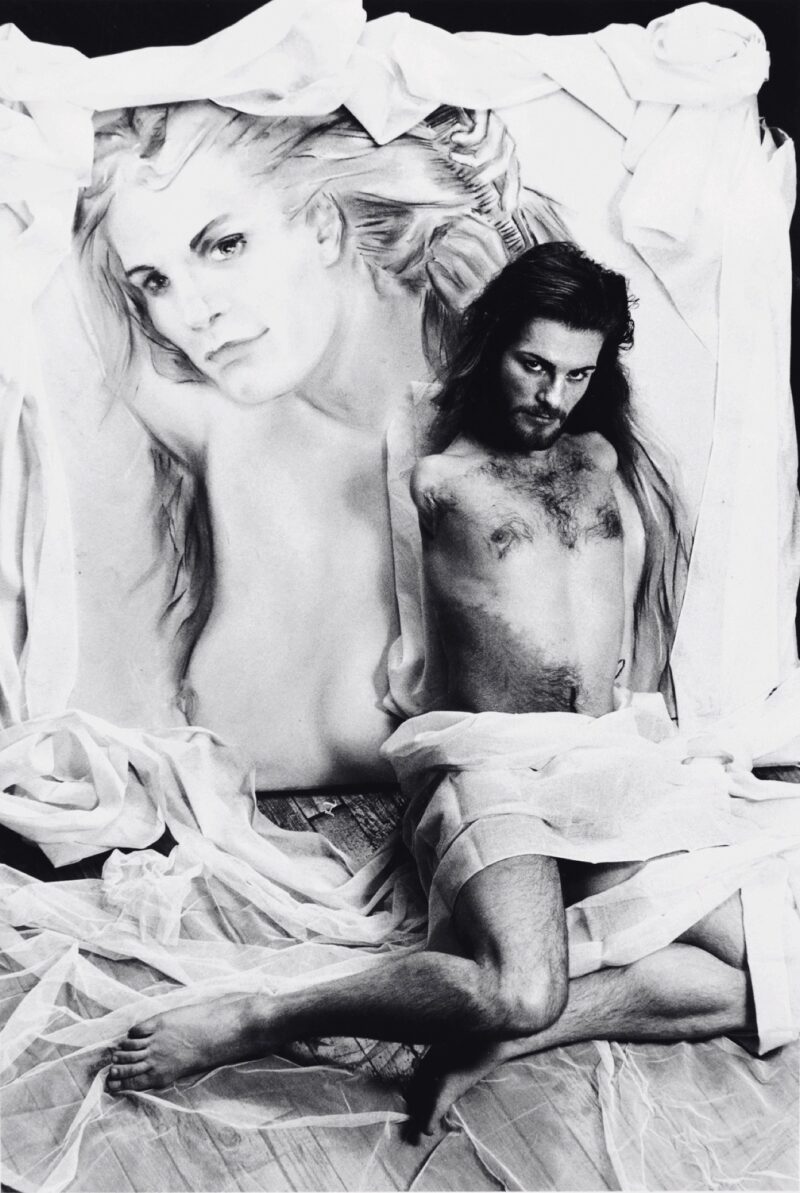
Lorenza Böttner, Sans titre / untitled, 1982, photographie noir et blanc / black-and-white photograph
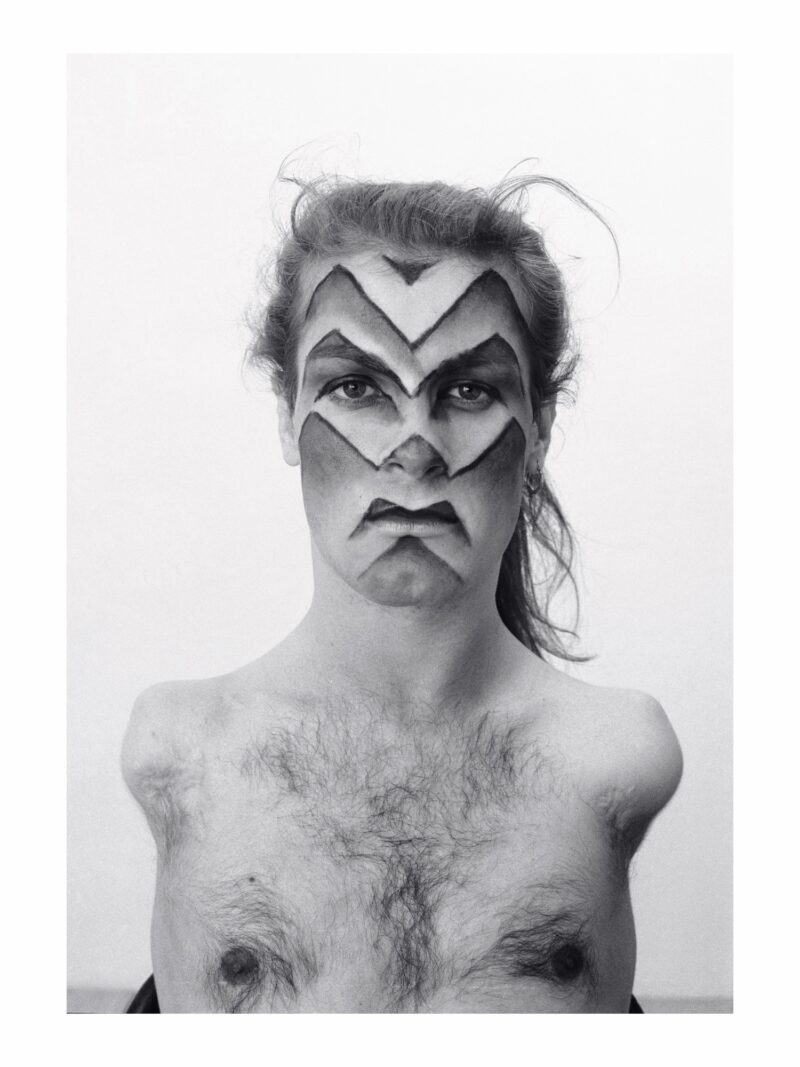
Lorenza Böttner, Face Art, 1983, photographie noir et blanc / black-and-white photograph

[Winter 2022]
Requiem for the Norm
By Fanny Bieth
Galerie Leonard & Bina Ellen, Montréal
29.04.2021 — 19.06.2021
Lorenza Böttner: Requiem for the Norm is the first international retrospective exhibition for the Chilean-German artist Lorenza Böttner, a trans person who lost both arms as a child following an accident. Böttner’s practice and life embody, to use the words of philosopher Paul B. Preciado, who curated the exhibition, a “political struggle for recognition and exaltation of [non-normative] life.” This political power shines within a remarkable and prolific body of work exhibited at the Leonard & Bina Ellen Gallery in spring 2021.
Requiem for the Norm brought together more than a hundred works and documents testifying to Böttner’s multidisciplinary art practice from when she entered the Gesamthochschule Kassel, in 1978, to her death in 1994, at age thirty-four, following AIDS-related complications. Large-format pastels, pencil and ink drawings, photographs, videos, dance, performance – not only does Böttner’s work involve a multitude of techniques, but her works transcend traditional art disciplines: painting becomes a dance; sculpture, the subject of a performance. Often featured in performances, Böttner’s body works as a true weapon of subjectivation of and resistance to normative systems. Indeed, the affirmation of Böttner’s subjective power upsets, at several levels, what Preciado calls somatopolitical regimes – techniques of production and control of bodies – chiefly, here, the medical system. Refusing to wear the prostheses intended to bring her body into conformity, Böttner left the care institution that was supposed to adapt her to an ableist environment to devote herself to her art. In doing this, she rejected the pathological perception of her body as disabled in order to express all of its agency – that of a dancing, painting, creating, desiring body.
Two works in the exhibition probe with particular acuteness the contingency of belief systems that inform our gaze at bodies with functional diversity. A pastel, made in 1985, portrays, in front of a background of pink fading to grey, Böttner in the pose, hairstyle, and draped garb of the Venus de Milo, a sculpture lauded for its aesthetic perfection and, like Lorenza, with both arms amputated. In this piece, as in all of her work, Böttner is interested in showing the power and beauty of maimed bodies, taking a stance in opposition to the invisibilization and desexualization that are so pervasive. Nearby, on a wall to the side, a small screen shows a video of the performance Venus von Milo 2, filmed in Munich in 1987. In the video, Böttner first appears immobile on a pedestal, draped like the Venus to the waist, and with her skin covered with a fine layer of plaster. After a few minutes, she speaks to the audience – “What would you think if art came to life?” – and then begins to dance. Inhabiting a body that is at first passive and silent, like the original sculpture and the neighbouring pastel, Böttner then reconstructs all of its power and vitality, transforming it from an object of contemplation to an active, speaking, and moving subject.
It was when she entered the art school that Böttner took the name Lorenza, further reinforcing her resistance to the gender binary that she had already been disrupting for a long time, if one believes a conversation between her and her mother in the 1991 documentary Lorenza: Portrait of an Artist, directed by Michael Stahlberg, screened in one of the exhibition galleries. The film brings out Böttner’s extreme sensitivity, freedom, and desire to be recognized and accepted in her uniqueness. In a series of thirty-two portraits, made in 1983 and hung on two of the gallery’s walls, Böttner makes up her face, remodels her facial hair, arranges her long hair, and dresses in a way that plays with the borders of identity and the norms and stereotypes that shape them.
The shadow of normative power appears here and there in the exhibition. We glimpse it, for example, in a newspaper article in which the author has systematically masculinized the artist’s name. In the version that is shown, each occurrence has been corrected in pen, perhaps by Lorenza herself. This revision, a true sign of resistance, points to one of the effects of the exhibition: its holding and its touring rectify the invisibilization of an important body of work, thus challenging the way in which a broad swath of artworks is obscured by the dominant canon – those very works that shake its foundation. Böttner’s retrospective and, more generally, the work of curator Preciado, operate in this sense as an admirable and welcome breath of fresh air. Translated by Käthe Roth.
Fanny Bieth is a doctoral student in art history at UQAM and copyeditor for the magazine Captures.