
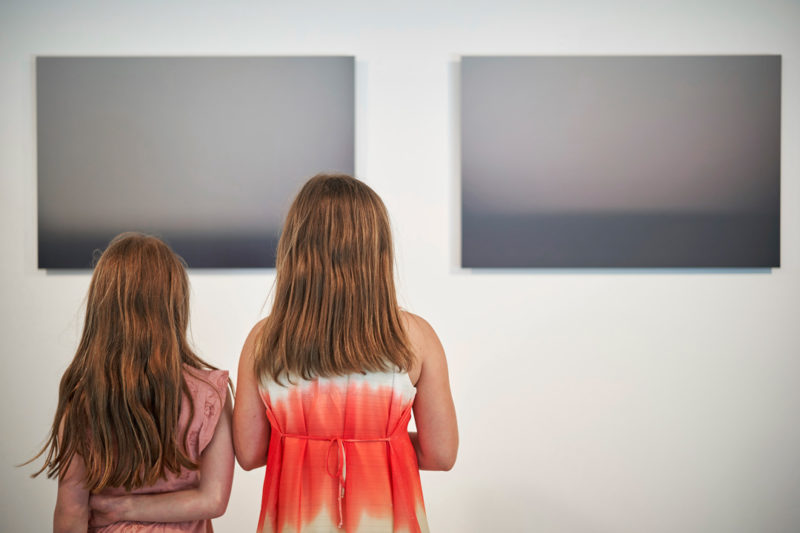
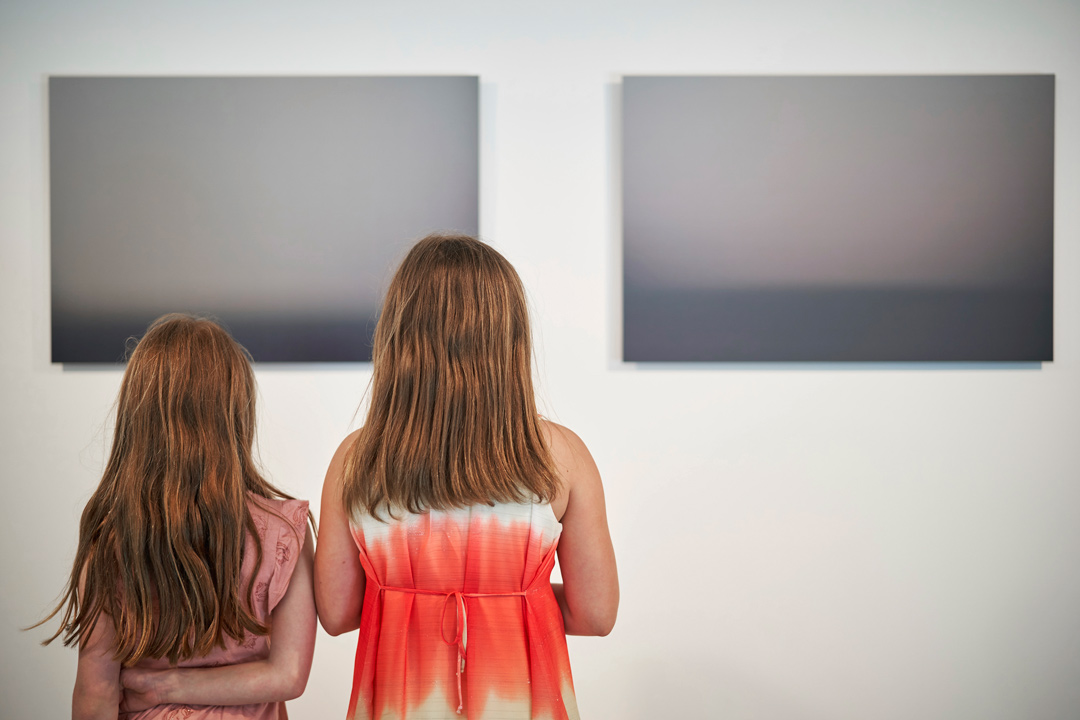
Martin Désilets, Lieux-monuments 11 et 12, New York, 2021, exposition / exhibition Les tableaux réunis, photo : Romain Guilbault

Martin Désilets, Lieux-monuments 15, Bâle, 2021, impression à jet d’encre sur papier photo Rag Baryta de Hahnemühle, montée sur aluminium / inkjet print on Hahnemühle Photo Rag Baryta paper, mounted on aluminum, 51 × 76 cm
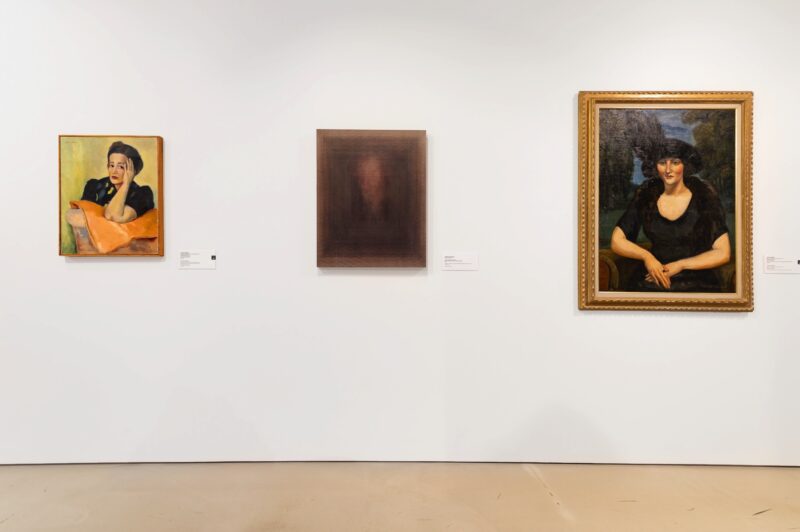
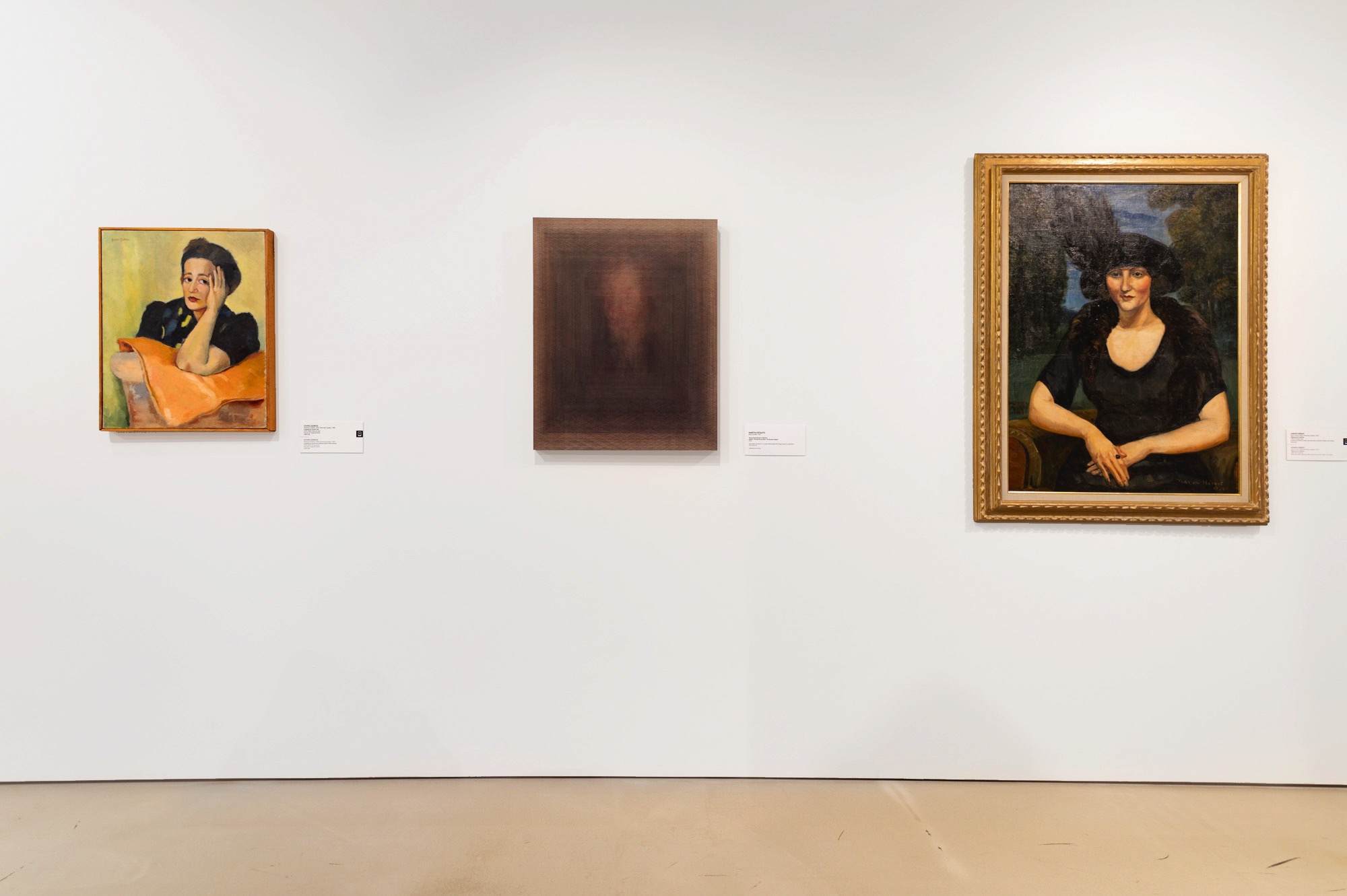
Martin Désilets, Tous les portraits de la collection, d’après « Portrait de ma sœur » de Suzanne Duquet, 2020, exposition / exhibition Les îles réunies, photo : Paul Litherland

[Winter 2022]
Martin Désilets, Les tableaux réunis
By Yannick Marcoux
Musée d’art de Joliette
19.06.2021— 6.09.2021
In a poem in his L’art poétique, Nicolas Boileau made a suggestion that has become famous: “Put your work twenty times on the anvil.” It seems that twenty times is not enough for the artist Martin Désilets, who, since 2017, has undertaken to photograph, and then superimpose digitally, all the modern and contemporary works in the museums that he visits. This voracious picture taking is for his project Matière noire, in which each group of a hundred superimposed works constitutes a “state.”
The exhibition Les tableaux réunis at the Musée d’art de Joliette (MAJ) featured three series of Désilets’s works. The first was Matière noire. The second was his most recent project, conceived during a residency at the MAJ, for which he used the same approach, taking as his subject the works in the museum’s permanent collection. The third, Lieux-monuments, was composed of photographs made by pointing a digital camera body, without a lens, at emblematic sites in three cities. Although it differs from the first two series aesthetically, this series is similar in approach and fed into the discursive loop of the works exhibited.
Summary works. Matière noire is the result of a systematic operation. In Désilets’s “states,” the works are accumulated by the hundred and superimposed over each other in a radically revisited approach to archiving. The unnamed works are there, before our eyes, in a palimpsest that jealously preserves the strata of its previous recordings.
The totality of these disembodied works is swallowed up. At the centre of the “states” is deployed a hint of frames with blurred contours, a glimpse of charcoal lines with angles repeated a thousand times, sometimes the respite of a few sepia waves, and an opaque atomic core that, as it spreads, becomes so light that it is sometimes melds into the museum’s walls.
The photograph is no longer a trace that reproduces reality, but an impermanent and hypnotic body. From this rectangular geometry arises an affective prison, a summary work that draws us into it, into the forms that our mind projects upon it. Yet, even more than the sum of a whole, Désilets summons the repeatedly renewed first contact during which spectators, with their fistful of emotions and experiences, encounter a work and the weight of its culture. Each time we stand before these “states,” there is a question: in the end, what remains of all this?
Draw me a sheep. The photographs in Lieux-monuments don’t have the hypnotic power, or the mysterious and dense beauty, of those in Matière noire. Of the captures of iconic sites in Montreal, New York, and Basel, nothing remains but a plane of bright colour, grazed by a line or curve, testifying to the passage of light into the camera.
The resulting non-images invite us to consider these places beyond their spectacular nature by refusing to add to the overconsumption of their photographic reproduction. Rather, Désilets exploits his misuses of the camera and travels back to the mechanisms at the origin of the image, in order to shake up the subject–photographer–spectator triad. He doesn’t dodge behind his subject but inscribes himself in it, providing a few traces of his presence. Echoing the other series, which make celebrated works invisible through accumulation, these works push the monument sites into the background. The result is an experience that is unstable and abstract but, in the end, perhaps more alive than the great delusion of a photograph that captures the real.
Impermanent memory. Désilets delved into the MAJ permanent collection and, following the method of Matière noire, photographed and superimposed all of its works, dividing them into four genres: still life, landscape, portrait, and abstract. Each of the four resulting photographs – or summary works – was exactly the same size as one work in the permanent collection and, amusingly, replaced that work in the exhibition.
Désilets’s works thus emerge in the heart of the collection, dissonant, saturated with black or white. In the portrait accumulation, which is distinct from the others, apparent smoke emerges, as if the frantic juxtaposition of paintings had set them ablaze.
Here, the game takes a new turn: unlike in Matière noire, Désilets names the paintings replaced. By evoking them, he sets up a dialogue with the sum of the works swallowed up, creating an instant paradox: even absent, the work is embodied. This idea brings to mind Jochen Gerz’s celebrated The Invisible Monument, a monument concealed beneath cobblestones in Saarbrücken, which is embodied through evocation.
By intervening in the permanent collection, Désilets, like Gerz, invites us, perhaps, to participate in the work itself and, incidentally, to bring it into the world. His summary works may thus be, rather than a monumental form of memory, an admission of incompleteness, a moving and organic force to which new works are added, over and over. Translated by Käthe Roth.
Yannick Marcoux contributes to magazines, blogs, and newspapers with articles, poems, literary criticism, and columns. Twice a finalist for the Radio-Canada literary awards (story and poetry categories) and recipient of the Prix de la nouvelle Pauline-Gill (2016), he published L’horizon des phares (Hamac), his first poetry collection, in 2021.