Accueil > Recent issues > Ciel variable 118 - EXHIBITING PHOTOGRAPHY

Ciel variable Magazine

Un magazine qui se consacre à la présentation et à l’analyse des pratiques de la photographie en lien à l’art contemporain, aux nouvelles technologies de l’image et aux enjeux actuels de la culture.

Main menu

Skip to content
  • RECENT ISSUES
  • BOUTIQUE
  • WEB COLUMNS
  • ARCHIVES
  • ABOUT
  • Français

Ciel variable 118 - EXHIBITING PHOTOGRAPHY

Show Grid Show List

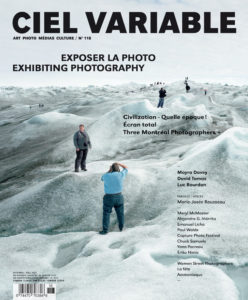
The thematic section in this issue presents three exhibitions that show how photography can contribute to shaping a critical vision of the world. The first sets out to offer an overall sense of the changes affecting global civilization. The second contrasts traditional photography with its mutant, digital, and interactive form. The third is the career of a photography critic whose vision is fed by the act of collecting.

Ciel variable 118 – EXHIBITING PHOTOGRAPHY

Ciel variable 118 - EXHIBITING PHOTOGRAPHY

[Fall 2021]
The thematic section in this issue presents three exhibitions that show how photography can contribute to shaping a critical vision of the world. The first sets out to offer an overall sense of the changes affecting global civilization. The second contrasts traditional photography with its mutant, digital, and interactive form. The third is the career of a photography critic whose vision is fed by the act of collecting.
Exhibiting Photography to Talk about Global Changes

Ciel variable 118 - EXHIBITING PHOTOGRAPHY | Editorial
Authors: Jacques Doyon

The thematic section in this issue presents three exhibitions that show how photography can contribute to shaping a critical vision of the world. By bringing together a large number of images and points of view, the first sets out to offer an overall sense of the changes affecting global civilization. Inspired by Jean Baudrillard’s notion of the “total screen,” the second contrasts traditional photography and its mutant, digital, and interactive form, which augments the real at the scale of a screen interface. The third highlights the career of a photography critic whose vision is fed by his encounter with the works he has collected and their creators, while being attentive to the development of a photographic community.

Exhibiting Photography

Ciel variable 118 - EXHIBITING PHOTOGRAPHY | Portfolios

[Fall 2021] Thematic presentation by Jacques Doyon The thematic section in this issue presents three exhibitions that show how photography can actively contribute to shaping a critical vision of the world. By bringing together a large number of images and points of view, the first sets out to offer an overall sense of the changes […]

William A. Ewing et Holly Roussell, Civilization – Quelle époque ! — Julie Martin, A Photographic Mapping of the Twenty­First Century

Ciel variable 118 - EXHIBITING PHOTOGRAPHY | Portfolios
Authors: Julie Martin | Artists: Massimo Vitali

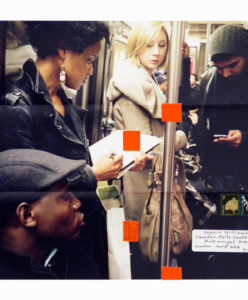
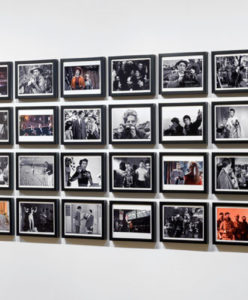
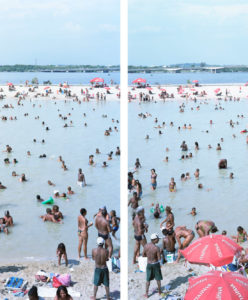
Two hundred works, a hundred and ten photographers, eight sections: this ambitious exhibition, observes critic Julie Martin, “offers a glimpse of the movements that run through today’s world: interrelations, invisible flows, influences, mobility of goods and human beings.” Martin bases her reflection on the principle of “cognitive mapping,” formulated by Fredric Jameson to evoke what escapes our gaze, our senses, and our experience. Although she sees Civilization as a descendant of Edward Steichen’s legendary exhibition The Family of Man, she underlines that this new show is a true panorama of diversity – and not a portrayal of capitalistic hegemony. “The curators do not renounce the idea of a human community,” Martin writes, “but they respect its disparities [and] make visible the mechanisms of power (hidden in The Family of Man) that shape our world.”

Amandine Alessandra, Marine Baudrillard, Carole Lévesque, Katharina Niemeyer et Magali Uhl, Écran total — Edward Pérez­-González, The Absence Machine

Ciel variable 118 - EXHIBITING PHOTOGRAPHY | Portfolios
Authors: Edward Pérez-González | Artists: Charlie Doyon

The result of a research project around Jean Baudrillard’s reflection on the notion of the “total screen,” this exhibition brings together seven artists who comment on the omnipresence of the screen and its effects on our lives. According to critic Edward Pérez-González, “the works that form the core of the exhibition are based on the critical vision of the world of Baudrillard the philosopher … a world in which the statement becomes the screen itself.” Baudrillard the photographer, whose images are present in the exhibition, proposes, as Pérez-González writes, “to capture the value of experience … of the ‘I’ that I am.” It is this subjectivity, linked to a body of work attentive to light, that is tending to disappear in the era of screens. “Through the accumulation of sequences, decontextualization, and schematization,” Pérez-González summarizes, “a disconnected world is shown and scrutinized soullessly.”

Robert Graham, Three Montréal Photographers + — Zoë Tousignant, Robert Graham’s History of Photography in Montreal

Ciel variable 118 - EXHIBITING PHOTOGRAPHY | Portfolios
Authors: Zoë Tousignant | Artists: Donigan Cumming, Michel Campeau, Tom Gibson

A reflection on Robert Graham’s activities as a critic and collector, this exhibition of three Montreal photographers (and more) opens broad perspectives. It accounts for an approach that combines the acquisition of artworks and spending time with their creators (in this case, Tom Gibson, Donigan Cumming, and Michel Campeau) with the development of a critical vision of photography. Zoë Tousignant defends the principle that an image is appreciated as much for what it doesn’t show as what it does show. She notes that Graham, whose collection comprises works that are “visual correlatives” of his thought, is interested in the parergon, Jacques Derrida’s concept that has it that “what resides outside of a work of art is in fact fundamental.” “Telling the history of photography in Montreal cannot involve the exclusion of all that is foreign,” writes Tousignant, who sees the inclusion in the exhibition of images by Muybridge, Tichý, and Parr as reflecting “the total imbrication of the local scene with the international.”

Moyra Davey. The Personal Narrative and the Art of Fragmented Anti-dogma Narration — Nicolas Mavrikakis

Ciel variable 118 - EXHIBITING PHOTOGRAPHY | Essays
Authors: Nicolas Mavrikakis | Artists: Moyra Davey

In reaction to “left-wing extremism” and campaigns for “art that is moral and bland, with no grey areas,” critic Nicolas Mavrikakis offers an impassioned reading of Moyra Davey’s practice, and specifically her video i confess (2019). This work, which addresses polarizing themes, leads, in Mavrikakis’s view, to reflection “beyond the opposition between good and evil.” Unclassifiable and complex, based on plays of images within the image, the video is “a sort of Russian doll” with multiple references, and Davey quotes James Baldwin and Pierre Vallières, among others. Like i confess, and Joyce Wieland’s film Pierre Vallières (1972), upon which Mavrikakis also comments, this essay rises against dogmas and suggests that we not get bogged down in fixed, simple readings of cultural history, including when we discuss Vallières, the author of White Niggers of America.

David Tomas, Speech and silence — Vincent Bonin

Ciel variable 118 - EXHIBITING PHOTOGRAPHY | Essays
Authors: Vincent Bonin | Artists: David Tomas

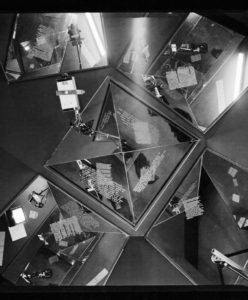
Invited by Ciel variable to re-evaluate David Tomas’s practice, Vincent Bonin offers a cross section of the intellectual trajectory of artist and anthropologist Tomas, who died in 2019. Bonin discusses the importance that Tomas accorded to silence, even up to his final work, which bore the ambiguous words “No Lot.” “This ‘no’ now resonates in the posthumous space, as a last form of the resistance of silence after the interruption of speech,” Bonin observes. The creator of kinetic installations marked by “semiotic complexity,” Tomas was known for his technological innovations (he began to use strobe lights, chronometers, and automatic triggers in the 1980s). He participated in the critical reassessment of the history of photography, as did Jeff Wall and Alan Sekula, while avoiding “statements of intent,” preferring to base his work on fragmentary or performative thought, and he remained silent even “when he was present.”

Luc Bourdon. Playing with Images and Sounds — Nicole Gingras

Ciel variable 118 - EXHIBITING PHOTOGRAPHY | Essays
Authors: Nicole Gingras | Artists: Luc Bourdon

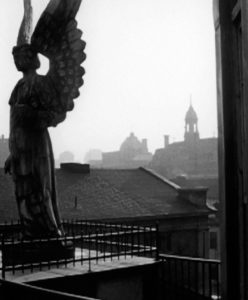
Luc Bourdon, a major figure in video and film, has produced some fifty works, many on the subject of culture, including La mémoire des anges (2008) and La part du diable (2017), built on material from the NFB archives. In this interview, conducted during celebrations of the fiftieth anniversary of Vidéographe, with which Bourdon has worked, Nicole Gingras talks to him about his early career, his love of words, and his vision of editing. Bourdon, who adopted video in the 1980s for its “potential of saying ‘I see,’” acknowledges that he was influenced by Gary Hill and Michael Snow. He owes them the idea of using images as “a means of inserting words and phrases” into his work. After creating in the “immediacy” provided by video, Bourdon became involved in productions that required “more energy and research,” such as La mémoire des anges, an “impressionistic” film on which he spent a good deal of time.

Meryl McMaster, There Once Was A Song — Stéphanie Hornstein

Ciel variable 118 - EXHIBITING PHOTOGRAPHY | Exhibition reviews
Authors: Stéphanie Hornstein | Artists: Meryl McMaster

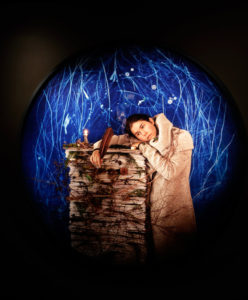
In the exhibition that Meryl McMaster organized during a residency during which she worked with the McCord Museum collection, she explored human beings’ paradoxical relationship with nature. To the birds under glass bell jars conserved by the museum, McMaster responded with works that, in Stéphanie Hornstein’s view, portray struggle and suffering related to the Dutch traditional vanitas style. Although the exhibition embraces “the transience of all lifeforms,” as Hornstein describes it, McMaster’s work is not pessimistic in tone. “Death, McMaster insists, is a natural, if disconcerting, process and instead of denying it – say, by sticking stuffed birds in bell jars – we would do well to learn from life’s cycles.”

Alejandro G. Iñárritu, Carne y Arena — Jean Gagnon

Ciel variable 118 - EXHIBITING PHOTOGRAPHY | Exhibition reviews
Authors: Jean Gagnon | Artists: Alejandro G. Iñárritu

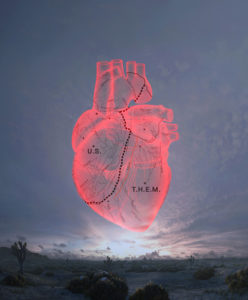
A fascinating voice in the growing medium of virtual reality, Alejandro G. Iñárritu’s solid reputation was borne out in his installation presented in Montreal, Carne y Arena. Jean Gagnon challenges the enthusiasm shown for this “exceptional storytelling experience,” although he acknowledges its high quality in that respect. “Iñárritu’s work,” he writes, “is even more ingenious, for his installation cannot be summarized simply in narration, and the experience is not simply virtual.” This work, out the ordeal of clandestine migration, “articulates something other than simulated reality” and reaches past the phenomenon of what is perceived. “Carne y Arena,” Gagnon concludes, “questions art’s effectiveness, role, and power to generate change by oscillating between emotion and intellect, the sensory and the intelligible.”

Emanuel Licha, zo reken — André Lavoie

Ciel variable 118 - EXHIBITING PHOTOGRAPHY | Exhibition reviews
Authors: André Lavoie | Artists: Emanuel Licha

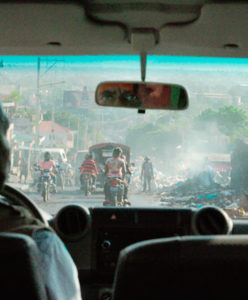
After years of creating representations of war, Emanuel Licha immerses himself in a Haiti in constant struggle. His documentary zo reken, closer to linear film than his previous works, draws on both recorded and offscreen images. “This is a habitual posture for him, as he probes the subjective nature of our gaze,” notes André Lavoie. The insurrectional atmosphere in the Haitian capital is viewed through a double frame: that of the camera and that of the windows of a zo reken (literally, shark bone), as the 4×4 vehicles used by foreign powers and humanitarian organizations are called locally. “From within this vehicle, Haiti is revealed in a perfectly defined aesthetic offering, a gaze delineated as if the spectator were also shut into this closed space.”

Paul Walde, Requiem for a Glacier — Reilley Bishop-Stall

Ciel variable 118 - EXHIBITING PHOTOGRAPHY | Exhibition reviews
Authors: Reilley Bishop-Stall | Artists: Paul Walde

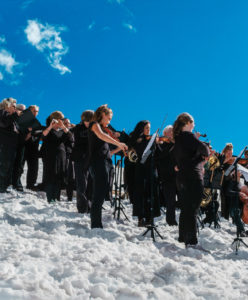
Initially an oratorio performed in situ, then a video installation, Requiem for a Glacier originated in a natural site in British Columbia threatened by a planned (and abandoned) ski resort project. As climate change continues to warm the planet, Paul Walde’s work, evocative of both mourning and struggle, remains relevant, even years after it was first performed. In images, it enhances “temporal and visual effects that mirror the dramatic urgency of the oratorio,” writes Reilley Bishop-Stall. However, the artwork as a whole is questionable in the eyes of the Ktunaxa nation. “The projection of such a … lamentation as a Latin Requiem onto sacred Ktunaxa territory raises … issues that cannot be avoided. That being said, Walde’s rooting of the score in both ancient Euro-Christian traditions and contemporary Canadian politics is potentially productive for evaluating the divergent interests.”

Capture Photography Festival 2021 — Karen Henry

Ciel variable 118 - EXHIBITING PHOTOGRAPHY | Exhibition reviews
Authors: Karen Henry

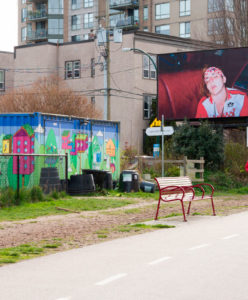
Given the multifaceted nature of the Capture festival, Karen Henry decided to focus on the part that took place in the public space. It must be said that the 2021 edition was not without controversy after the sudden removal of Steven Shearer’s series devoted to sleep. “The sleeping subjects are inherently vulnerable,” Henry notes, “and they made a number of people uneasy.” Henry had a number of questions concerning this “debacle.” Had the organizers taken account of the fentanyl crisis raging in Vancouver? Had an advertising company decided what could be seen? Henry also reviews other projects, including those by Anique Jordan and Jordan Bennett, which, by talking about Black or Indigenous communities, “evoke the ongoing experience of loss, but also hold the promise (and challenge) of so much more to be said.”

Chuck Samuels, Becoming Photography — Sylvain Campeau

Ciel variable 118 - EXHIBITING PHOTOGRAPHY | Exhibition reviews
Authors: Sylvain Campeau | Artists: Chuck Samuels

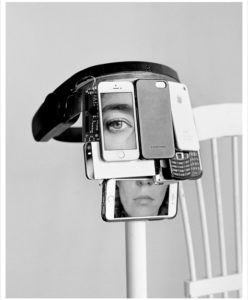
Chuck Samuels has been delving into the mise en abîme of photography, and the photographic portrait, since 1991. Brought together under the title Becoming Photography in exhibitions in two venues, these different bodies of work arise from two paradigms, in Sylvain Campeau’s view: the now-settled issue of the originality of an artwork and the current universe of “unending ramifications.” Campeau acknowledges that the evolution of Samuels’s practice, between appropriation of the reputation of “illustrious forebears” and contestation of the “hierarchy of people and genres,” fits within the “dissolution of barriers among media,” which are now all similar, all digital. “This desire to become the photograph,” he notes, “was deployed at the very moment when it could provoke only out-and-out rejection.”

Yann Pocreau, Les Impermanents — Daniel Roy

Ciel variable 118 - EXHIBITING PHOTOGRAPHY | Exhibition reviews
Authors: Daniel Roy | Artists: Yann Pocreau

Continuing Yann Pocreau’s reflections on the materiality of light, Impermanencies brought together works inspired by the celestial vault. With photographs of all types, including some produced without a camera, Pocreau ventured, as Daniel Roy notes, into a meditation on the cosmos, time, “the fleetingness of life, and the finiteness of living beings and things.” His experiments with the printing of light was redolent with homage to the pioneers of photography. And there’s more. The presence of prints not treated with fixer, “doomed to imminent extinction,” introduced thoughts about “all the creators whose names are lost to history, who have been erased by time.” As Roy observes, “The photograph is not as permanent as might have been desired. It can be altered. Memory, too.”

Érika Nimis, Mutants — Christian Roy

Ciel variable 118 - EXHIBITING PHOTOGRAPHY | Exhibition reviews
Authors: Christian Roy | Artists: Érika Nimis

Erika Nimis’s photographic practice, both documentary and experimental, leads her to find traces of places and abandoned objects. The body of work titled Mutants – reproductions of documents, close-ups of text excerpts, images of places, people, and objects – is the result of her discovery of the site of the University of Mutants, which no longer exists. The institution, once situated on the Senegalese island of Gorée, supported research on “endogenous alternatives” that might, in Christian Roy’s view, have resulted in a different world, developed in the Southern Hemisphere. This “uchronic utopia” is reflected in Nimis’s melancholic images. “Combining Afrofuturism and retrofuturism, Mutants offers an archaeological immersion in this site left in the planning stage,” Roy notes, concluding that this “photographic research project … is both inspiring and poetic.”

Women Street Photographers — Ariane Noël de Tilly

Ciel variable 118 - EXHIBITING PHOTOGRAPHY | Readings
Authors: Ariane Noël de Tilly

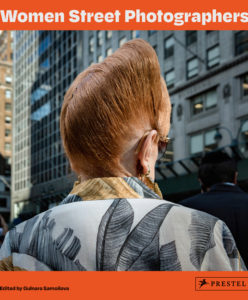
Like the photograph appearing on the cover, the book’s intention is obvious: to direct our attention toward a woman who is looking. “That is exactly what Women Street Photographers invites us to do,” writes Ariane Noël de Tilly, “to get to know the work of women photographers and the … events that they have captured in the public space.” Noël de Tilly describes this project, compiled from a series of annual exhibitions with the same title, as offering an overview in one hundred photographs whose rather free association “highlights the great variety of approaches to street photography.” This heterogeneous organization underlines “the happy coincidences linked to our experience of the public space.” Of the two essays included in the book, one evokes the intersection since the nineteenth century of two histories: that of photography and that of the status of women.

La fête : The People Came to Party — Dayna McLeod

Ciel variable 118 - EXHIBITING PHOTOGRAPHY | Readings
Authors: Dayna McLeod

“A feast for the heart, head, and soul,” is how Dayna McLeod describes La Fête, the perfect book to look at in the context of deprivation and isolation caused by the pandemic. The hundred photographs gathered from a call for submissions from Quebec and Brazilian artists are documentary, portraiture, and candid images. Freely associated but carefully organized, they offer a “gateway to feelings,” “a journey of party places and people,” “party and reverie … that pull on our memories, longing, and fear of missing out.” Although an audio application gives the images a sound environment, the essays give them meaning by teasing out the political momentum of the theme.

Alexis Desgagnés, Ammoniaque — Ève Dorais

Ciel variable 118 - EXHIBITING PHOTOGRAPHY | Readings
Authors: Ève Dorais | Artists: Alexis Desgagnés

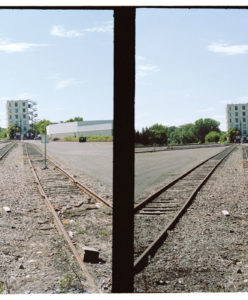
Offering views of an industrial neighbourhood in the Montreal district of Hochelaga, Ammoniaque elegantly combines the documentary approach – “the importance of the subject and the picture taking,” as Ève Dorais specifies – and the materiality of the photograph through the use of analogue cameras and photosensitive film. In Dorais’s view, Alexis Desgagnés’s “off-axis photographic gaze” and attention to details give rise to an almost-spiritual dimension. Desgagnés – who is also an art historian, curator, and poet –explores words written on a corrugated-iron wall to uncover urban poetry. Similar to Claude Gauvreau’s Exploréen language, the words are imbued with “pain, incongruity, and euphoria.” This is an essential book, Dorais says, because it makes us aware of an urban space that falls between the cracks but is full of humanity, and it “encourages us to reconsider our conceptions of landscape and of beautiful photography.”

Marie-Josée Rousseau, At the Crossroads of Photographic Practices — Jérôme Delgado

Ciel variable 118 - EXHIBITING PHOTOGRAPHY | Entrevues
Authors: Jérôme Delgado

Founder of the only gallery in Quebec devoted exclusively to photography, Marie-Josée Rousseau talks about her motivations and her role in the art market. She came to photography through digital technology – which allowed her “unparalleled exploration” – has become a spokesperson for the image as object. In her view, “photography must be embodied in an object that can be seen and touched.” She sees her gallery, La Castiglione, as a crossroads of currents, disciplines, and schools of thought. The name refers to a historical figure in photography used by Rousseau so that it “could grow outside of me” and with whom everyone would identify – “a concept that isn’t as easy when the name of the owner is front and centre.” Having become nomadic in 2020, La Castiglione and its business model have to be rethought, and Rousseau has given herself a year to consider how its activities will continue.

Taxonomy navigation

← Ciel variable 117 - SHIFTED
Ciel variable 119 - AGAINST NATURE →
BOUTIQUENEWSLETTER
Or use the Advanced Search

The Magazine

  • On Newsstands
  • RECENT ISSUES
  • Online Boutique
  • Subscriptions

Online

  • The Photobook
  • Documentary Photography
  • Artists' Projects
  • Biennials & Co.
  • Exhibition Reviews
  • Under Other Skies

Ciel variable

  • Submission
  • Advertising
  • Supporting the Magazine
  • ABOUT
  • Terms & Conditions

Follow us!

logo facebook
logo instagram
© Magazine Ciel variable 2026
5445, Av. de Gaspé, bureau 612, Montréal, Qc, Canada H2T 3B2 – 514/390-1193 – info [arrobas] cielvariable.ca